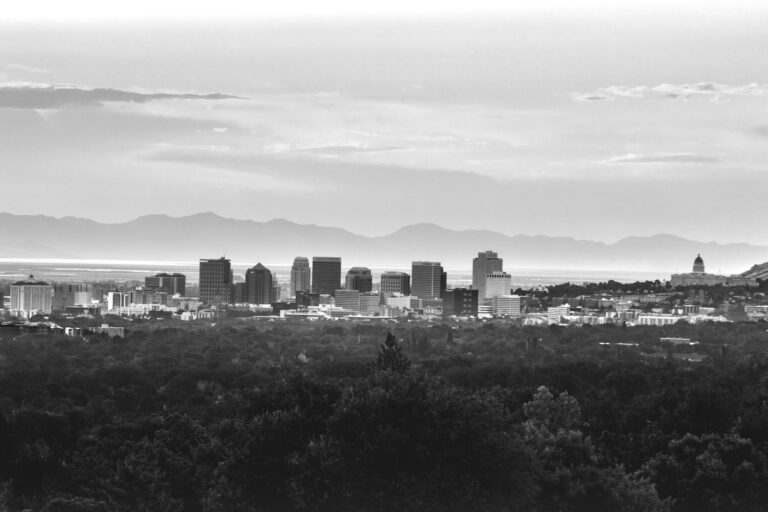

Sioux Falls renter demand is driven by a simple combination: a city that keeps adding several thousand residents a year, an economy anchored by two large health systems and a national banking cluster, and a labor market so tight that newcomers keep arriving for work. About four in ten Sioux Falls households rent, and that share sits on top of a population that has grown by more than 10% since the 2020 census.
Demand is only half the story, though. Sioux Falls has also permitted thousands of apartment units since 2020, and vacancy has drifted up as those buildings opened. This article looks at both sides using city, Census Bureau and Bureau of Labor Statistics data: who is moving to Sioux Falls, what they do for work, how renters fit into the housing mix, and what the construction cycle means for owners of existing buildings.
Population growth behind Sioux Falls renter demand
The 2020 census counted 192,517 people in Sioux Falls. The Census Bureau’s own estimate put the city at 213,748 on July 1, 2025, an increase of 10.9% in a little over five years, according to U.S. Census Bureau QuickFacts for Sioux Falls.
The city’s planning office uses a different method and reaches a higher number. Its January 2025 estimate was 224,676 residents, an addition of 5,088 people, or 2.3%, in a single year, and 42,176 residents over the previous eight years. The two figures are not contradictory so much as differently built, because the city and the Census Bureau use different estimating methods and dates. Either way, the direction is the same, and the pace is fast for a Midwestern city.
The wider region is growing too. The metro area counted 276,730 residents in the 2020 census under its old four-county definition. It is now defined as five counties, Minnehaha, Lincoln, McCook and Turner in South Dakota plus Rock County in Minnesota, and the city estimates the metro at 312,400 as of the end of 2024. A larger commuter shed matters for apartments because many renters who work in Sioux Falls choose to live close to jobs rather than drive in from small towns.
Sioux Falls straddles two counties. Most of the city is in Minnehaha County, but the southern edge reaches into Lincoln County, and that is where much of the recent growth has gone. In the 2020 census, 156,163 residents lived in the Minnehaha portion and 36,354 in the Lincoln portion. By the city’s January 2025 estimate, those figures were 172,357 and 52,319. In other words, the Lincoln County side grew by roughly 44% in under five years.
The City of Sioux Falls 2025 Development Summary also shows housing units rising from 83,504 at the 2020 census to an estimated 98,864 in January 2025. For an owner, the geography is worth noting. New subdivisions and new apartment communities on the growing southern edge compete for the same renter households as older buildings in central neighborhoods, and the two counties have separate assessors and tax rates.
A health-care economy at the core
No single fact explains Sioux Falls renter demand as well as its health-care sector. The city is headquarters to two regional health systems, and the Sioux Falls Development Foundation’s major employers list, updated in June 2026, ranks them first and second:
- Sanford Health and the Good Samaritan Society: 11,000 to 11,500 employees
- Avera Health: 9,500 to 10,000 employees
- Sioux Falls School District: 3,500 to 4,000 employees
- Smithfield Foods: 3,000 to 3,500 employees
- Amazon and Hy-Vee: 2,000 to 2,500 employees each
- Citi, Wells Fargo, First PREMIER Bank/PREMIER Bankcard and the VA medical and regional office: 1,000 to 1,500 employees each
Health-care employment is unusually good for apartments. Hospitals run around the clock, hire across a wide pay range from nursing assistants to physicians, and recruit residents, travelers and new graduates who often rent before they buy. Health systems also keep investing. The city’s 2025 permit report lists Avera’s women’s and children’s expansion, valued at $131 million, and Good Samaritan’s Founder’s Crossing, valued at $109 million, among the three largest projects of the year.
Card banking, logistics and food processing
Sioux Falls became a financial-services city through a sequence of decisions more than four decades old. South Dakota eliminated its usury limits on interest rates in 1980, and Citibank moved its credit card operations to Sioux Falls in 1981. Other card issuers and banks followed over the years, and today Citi, Wells Fargo and First PREMIER each employ 1,000 to 1,500 people locally. Back-office and customer-service roles in banking tend to produce exactly the kind of steady, salaried renter that apartment owners prize.
Logistics and food production add a second, more blue-collar layer of demand. Smithfield Foods, with 3,000 to 3,500 local employees, anchors food processing. Amazon opened its first South Dakota fulfillment center in Sioux Falls in fall 2022, announced with about 1,000 full-time jobs, and the Development Foundation now lists it at 2,000 to 2,500 employees. The largest single project on the city’s 2025 permit list was a $170 million CJ Foods facility. Plant and warehouse jobs, many of them shift-based, tend to support demand for older, more affordable apartments with easy commutes.
A labor market with very little slack
The BLS economy-at-a-glance page for the Sioux Falls metro shows how tight the job market is. In August 2026, the metro had about 184,500 nonfarm jobs and an unemployment rate of 2.2%, both preliminary and not seasonally adjusted. The largest sector was education and health services with 39,600 jobs, followed by trade, transportation and utilities with 37,700, and leisure and hospitality with 20,300.
An unemployment rate near 2% means employers have to recruit from outside the region to fill openings. Recruited workers usually arrive without a home to move into, which is why in-migration and renter household formation track each other closely in Sioux Falls. It also means wage pressure, which over time supports rent growth for owners who keep buildings in good condition.
One structural factor helps with recruitment: South Dakota has no personal income tax, one of eight states without one according to the Tax Foundation figures the state cites in its own fiscal reporting. For a nurse or analyst comparing offers from Minneapolis or Omaha, that can tip the decision.
Students and the research park
Sioux Falls is not a college town in the way Vermillion or Brookings are, but higher education adds a steady layer of young renters. Augustana University reported a record 2,652 students for the 2026–27 school year, up 4%, including 586 first-year students. The University of Sioux Falls adds another private campus, and the University of South Dakota’s Sioux Falls presence is growing through its research park.
The longer-term play is research. The USD Discovery District research park is an 80-acre campus run by the University of South Dakota with the city, the Board of Regents, the governor’s economic development office and Forward Sioux Falls. Its first building, 50,000 square feet for biotech and life-science companies, opened in January 2025. At full build-out, projected over roughly 25 years, the district is expected to hold 26 buildings worth more than $314 million and nearly 2,800 jobs. Those are projections, not commitments, but they point toward more professional, often early-career renters in the decades ahead.
How renters fit the Sioux Falls housing mix
According to the 2020–2024 American Community Survey, 59.5% of Sioux Falls housing units are owner-occupied, which means about 40.5% of households rent. The average household has 2.28 people. Median gross rent over the same period was $1,035 a month, against a median household income of $75,970 and a median owner-occupied home value of $292,400.
Those numbers describe a market where renting is common but not dominant, and where rents remain modest compared with incomes. A household earning the median income and paying the median rent spends roughly 16% of gross income on housing, well below the 30% threshold usually used to define cost burden. That headroom is part of why newer, higher-priced buildings have been able to lease up, and it suggests older buildings may have room to recapture value through renovation, provided supply conditions allow it.
Note that these are multi-year survey averages. They lag the market, so recently signed leases in new buildings typically run above the ACS median, while long-tenured units in older buildings often sit below it.
The supply side: permits and vacancy
Developers responded to all that demand. The city’s permit data shows the number of multifamily units permitted each year:
- 2020: 1,571 units
- 2021: 1,821 units
- 2022: 3,343 units
- 2023: 1,930 units
- 2024: 1,256 units
- 2025: 1,168 units
The 2022 spike is the number to watch. Apartment buildings permitted in 2022 generally took two or more years to finish, so much of that wave reached the market in 2024 and 2025. Since then, permitting has eased by nearly two-thirds from the peak. The city’s 2025 building permit report puts the year in context: total construction value was $1.327 billion across 5,615 permits, the fifth straight year above $1 billion.
Vacancy reflects the delivery wave. The South Dakota Multi-Housing Association’s January 2026 survey, as reported by SiouxFalls.Business, found 954 of 14,409 surveyed units empty, a 6.62% vacancy rate, up from 5.68% in July 2025. Market-rate vacancy was 6.41%, tax-credit properties 8.21% and HUD-assisted properties 3.51%. The same report noted 270 multifamily units permitted through February 2026, compared with 192 a year earlier, a hint that starts may be stabilizing.
Read together, the data shows a market digesting a lot of new product in a healthy economy, not one with weak demand. The very low vacancy in HUD-assisted housing is a reminder that demand is strongest at the lower end of the rent range, where new construction rarely competes.
Fewer starter homes, more attached housing
The permit mix says something about where future renters will come from. Of the 1,999 housing units the city permitted in 2025, 1,168, or about 58%, were in multifamily buildings. Single-family construction fell to 357 units, the lowest in ten years, while townhouse units climbed from 331 in 2023 to 344 in 2024 and 403 in 2025.
When fewer detached starter homes are built, households that might once have bought early tend to rent longer, and some move into townhomes instead. With a median owner-occupied home value of $292,400 in the 2020–2024 survey, buying is a bigger step than renting for a household new to the area. That dynamic tends to support demand for larger apartment units, two- and three-bedroom layouts, that can house young families who are not yet ready or able to buy.
It also changes the competition. Owners of older apartment buildings increasingly compete with for-rent townhomes and new garden communities for the same household, so features that new construction offers, such as in-unit laundry, garages and storage, can matter more in leasing than they did a decade ago.
Overall housing supply has kept pace with population rather than racing ahead of it. By the city’s estimates, housing units rose about 18% between the 2020 census and January 2025, from 83,504 to 98,864, while the city’s population estimate rose about 17% over a similar span. That is a reasonable balance over five years, even if the timing of deliveries created a temporary bulge in apartment vacancy.
The policy backdrop for rental owners
South Dakota’s legal framework is light-touch for landlords, which affects how owners can respond to demand. South Dakota’s statewide ban on local rent control (SDCL 6-1-13) bars cities and counties from adopting any rule that controls rent on private residential property, so Sioux Falls cannot cap rent increases. State law also caps security deposits at one month’s rent unless both sides agree to more because of special conditions, under SDCL 43-32-6.1. Market rents, not regulation, set the pace of income growth.
What the demand picture means for owners
For someone holding or evaluating apartments in Sioux Falls, the data supports a few practical conclusions:
- The long-run demand base is broad. Health care, banking, logistics, food processing and education employ residents across the income range, which spreads risk.
- The near-term issue is supply. With vacancy above 6% in early 2026, concessions and slower lease-ups are likely in submarkets with many new buildings, particularly on the growing southern edge.
- Older, well-run buildings have a niche. Low vacancy in assisted housing and modest median rents suggest steady demand for clean, affordable units that new construction cannot match on price.
- Watch the permit trend. If multifamily permitting stays near 1,200 units a year while population keeps growing by several thousand, today’s vacancy should tighten as the 2022 wave is absorbed.
- Check the county line. A building on the Lincoln County side sits in the faster-growing part of the city but is assessed and taxed by a different county than one in Minnehaha County, so expense comparisons should be made within the same county.
- Match the unit mix to the employer base. Hospital shift workers, bank staff, warehouse employees and students value different things, from proximity and parking to price and lease length, and the strongest buildings tend to know which group they serve.
None of these trends guarantees a particular result for a particular building. A well-located property near major employers can still struggle with deferred maintenance, and an older building on the edge of town can thrive if it is the best value in its rent range. The value of the citywide data is in framing the right questions: who the likely renter is, what that renter can afford, and how many new units will compete for them over the next two years.
Those conclusions feed directly into value. An owner can test how a change in rent or occupancy moves a building’s worth with our apartment building value calculator. Owners comparing Sioux Falls with other cities in the state can start from our South Dakota markets page, while our Sioux Falls market page stays focused on local conditions.