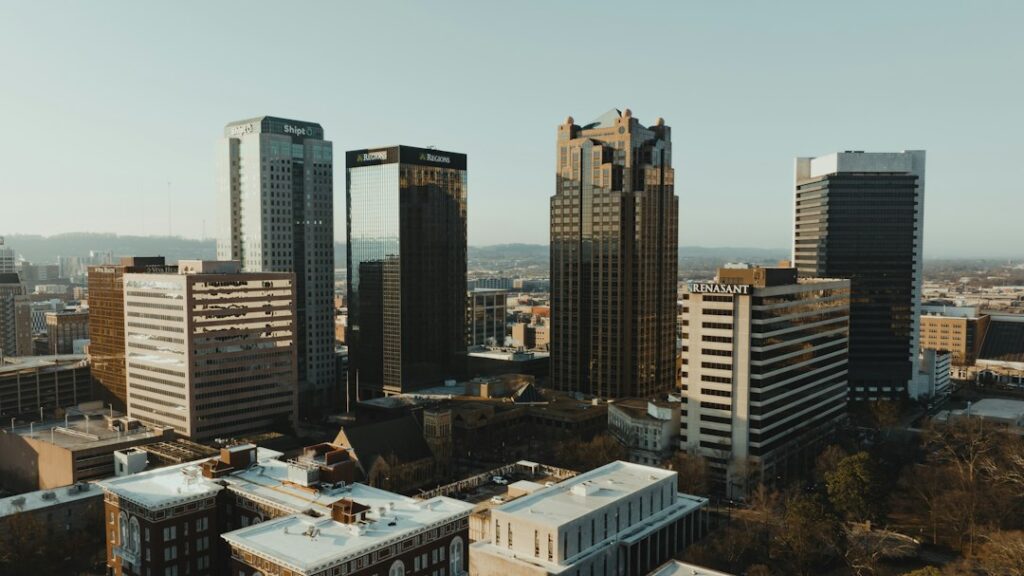
Renter demand in Birmingham, AL rests on three things: a large institutional employer base anchored by UAB, a housing market where most households rent, and a downtown core that has been filling up faster than new units arrive. The city’s headline population is edging down, so the demand story is about who is here and where they want to live, not raw growth.
For apartment owners, that distinction matters. Birmingham is not a market where rising tides lift every building. Location relative to jobs, the medical district and the city center does most of the work.
A renter-majority city with a shrinking headcount
According to the U.S. Census Bureau’s QuickFacts for Birmingham, the city had an estimated 195,893 residents on July 1, 2025, down from 200,486 at the April 2020 census base, a decline of about 2.3%. The wider Birmingham metro area is much larger, at roughly 1.2 million people in the Census Bureau’s 2025 estimate, and the city is the county seat of Jefferson County.
What stands out for owners is tenure. QuickFacts puts Birmingham’s owner-occupied housing rate at 45.5% for the 2020–2024 survey period, which means a majority of occupied homes in the city are rented. The same data shows a median gross rent of $1,107 and a median household income of $46,051 (in 2024 dollars), with about 2.1 people per household. Small households and moderate incomes favor studios, one-bedrooms and older, well-kept walk-up buildings over large luxury units.
The employers that keep units leased
The single biggest demand driver is the University of Alabama at Birmingham. UAB describes itself as Alabama’s largest employer, with more than 35,000 employees, and its campus covers 105 city blocks on the Southside. Fall 2025 enrollment was 20,868 students. A health system and research university of that size produces steady demand from residents, fellows, nurses, graduate students and staff, much of it concentrated within a short drive of the medical center.
Birmingham is also a headquarters town for financial services. Regions Financial is based in the city, and Protective Life’s head office sits on U.S. Highway 280. Those employers add white-collar renters who tend to favor downtown, Southside and the corridors toward the southern suburbs.
- Healthcare and education: UAB’s workforce and student body support demand across Southside, Five Points South and nearby neighborhoods.
- Finance and insurance: corporate offices downtown and along Highway 280 draw professionals who rent close to work.
- Startups and tech: Innovation Depot, a nonprofit incubator operating since 1987 in a 140,000-square-foot former Sears building on 1st Avenue North, keeps early-stage companies and their employees in the city center.
Downtown occupancy is tightening
The clearest recent signal comes from REV Birmingham’s Downtown Vitality Report. As Bham Now summarized in August 2026, downtown residential occupancy rose from 79% in the second half of 2025 to 84% in the first half of 2026, after 548 units were added in 2025. Downtown has about 14,700 residents and holds roughly 35% of the city’s jobs. Local TV coverage of the same report noted that new construction is expected to stay slow until occupancy approaches about 90%.
That combination of absorbing recently delivered units while the construction pipeline stays thin is what owners of existing downtown and near-downtown buildings want to see. Public investment has helped too: City Walk BHAM, a 31-acre linear park that opened in 2022 beneath the I-59/20 corridor, turned a barrier between neighborhoods into an amenity.
Neighborhoods where renter demand concentrates
Demand is not evenly spread. A few areas account for a large share of apartment interest:
- Five Points South and Southside: next to the UAB campus, with dining and nightlife that appeal to students and medical staff.
- The Loft District: roughly 20th to 26th Streets North, where former warehouses have been converted to loft apartments and condominiums.
- Avondale: a formerly industrial area on the northern slope of Red Mountain that has revived around breweries, restaurants and studios since 2011.
Buildings in or near these areas generally lease on proximity to work and amenities. Properties farther out compete more on price and condition, and owners there feel the city’s population decline more directly.
What owners can take from the demand picture
Birmingham’s renter base is real and durable, but it is uneven. A few practical takeaways for owners and passive investors:
- Underwrite to the submarket, not the city. Downtown occupancy data tells you little about a building in a neighborhood that is losing population.
- Match unit mix to households. With about two people per household and a median income near $46,000, efficient one- and two-bedroom units are the core of demand.
- Watch the downtown pipeline. If occupancy approaches 90%, new projects are likely to restart, which would change the competitive set for older buildings.
- Track UAB. Its hiring and enrollment trends are the closest thing Birmingham has to a demand barometer.
If you want to test how rent and occupancy assumptions change a building’s income, our NOI calculator is a quick way to run scenarios. For broader context on the state, see our Alabama multifamily market overview, and owners weighing an exit can read about selling an apartment building in Birmingham on our city page.