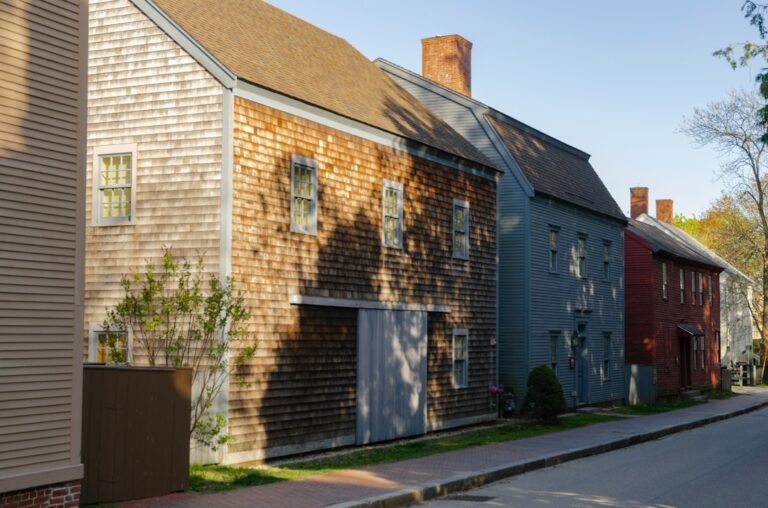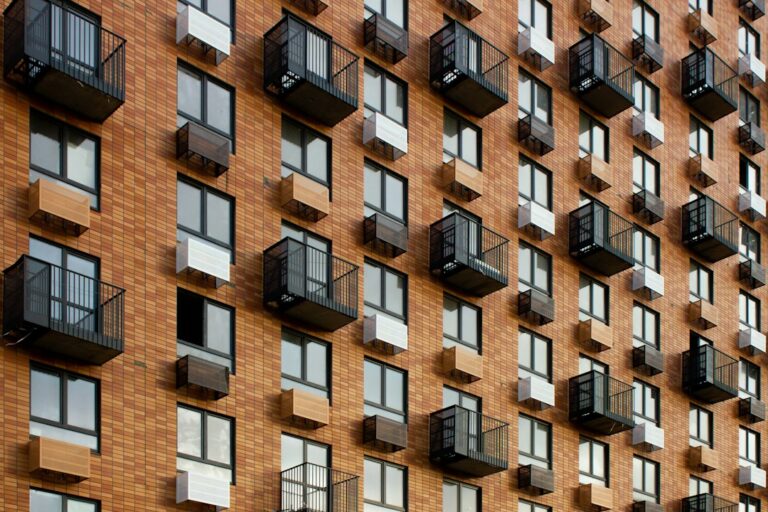
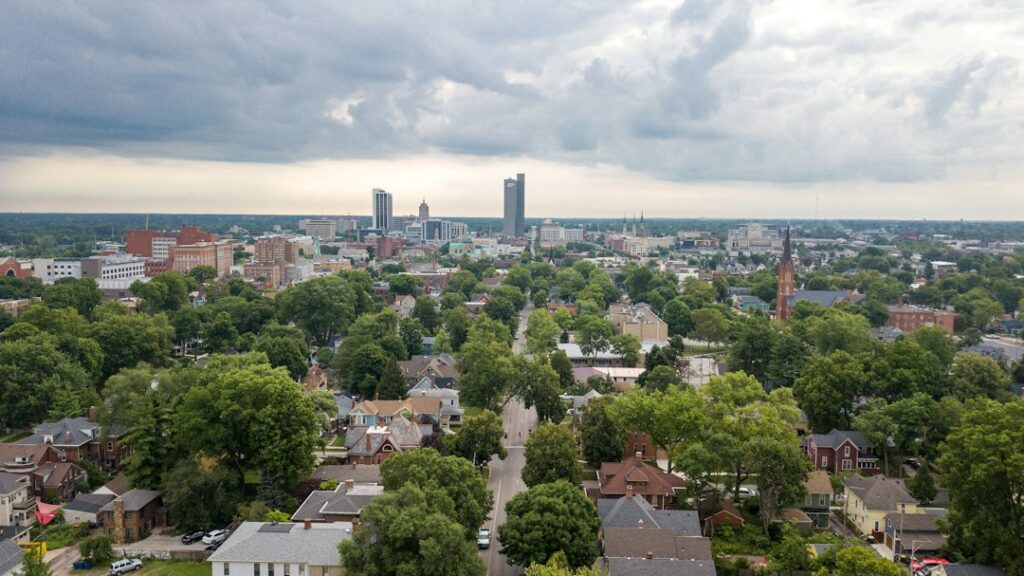
Fort Wayne apartment submarkets fall into a handful of distinct areas, and each holds a different kind of building: new mid-rise and adaptive-reuse projects downtown, early-1900s houses split into units in West Central and the ’07, workforce and affordable communities in the Southeast, student and medical-corridor demand on the north side, and suburban garden complexes in the southwest and Aboite. Knowing which one a property sits in tells an owner more about its tenants, its age and its likely capital needs than the city name alone does.
Fort Wayne is the seat of Allen County and its largest city. The Census Bureau counted 263,886 residents in April 2020 and estimated 275,203 as of July 1, 2025, across 110.74 square miles of land. The 2020-2024 American Community Survey puts the owner-occupied rate at 61.9% and the median gross rent at $999, which means roughly four in ten households rent (all figures from Census QuickFacts for Fort Wayne city). That renter base is spread unevenly, and the sections below walk through where it lives and in what kind of housing.
How Fort Wayne’s apartment stock is organized
Fort Wayne has no official list of rental submarkets, so the boundaries here follow the way the city’s own planning documents, historic district guides and housing studies divide it. Three forces shaped the map:
- The rivers and the old core. The St. Marys, St. Joseph and Maumee rivers meet at downtown, and the oldest housing, from the canal era through the 1920s, sits in the neighborhoods ringing that core.
- Annexation. The city grew outward in a series of annexations. A city release lists the 2006 Southwest Extended annexation (12.86 square miles, 22,587 residents), the North 1-3 annexations of 2001-2002 and the Northeast 1-5 annexations between 1990 and 2004. A proposed North IV annexation of about 22,000 people was rejected by City Council 7-2 in May 2016.
- Employment corridors. Much newer apartment construction followed jobs and retail to the north (Dupont Road and the Parkview Regional Medical Center area) and the southwest (Jefferson Boulevard and Illinois Road).
The annexation history matters for owners. A Fort Wayne mailing address does not guarantee a property is inside city limits, and the taxing district, zoning authority and service providers follow the municipal boundary, not the ZIP code.
Downtown Fort Wayne: new construction and adaptive reuse
Downtown holds the city’s newest and most expensive apartments, alongside some of its oldest converted buildings. The city’s 2025 Housing Market Potential study by Zimmerman/Volk Associates, released December 17, 2025, surveyed 10 downtown rental properties containing nearly 1,600 apartments. Seven of the 10 had been built or renovated since 2018. Half were at or above 95% occupancy, three were above 91%, and two recently built properties were still leasing up.
Reporting on the same study listed surveyed downtown rents of $950 to $2,365 for one-bedrooms, $1,299 to $3,960 for two-bedrooms and $1,449 to $4,863 for three-bedrooms. Those ranges sit far above the citywide median gross rent, which shows how much of downtown’s inventory is new, amenity-heavy product. The study projects that downtown can absorb up to 263 rental units a year over the next five years, up from about 212 a year in the 2021 study.
The riverfront
Promenade Park, a 4.5-acre, roughly $20 million park spanning both banks of the St. Marys River, opened in 2019 and anchored the riverfront building that followed. The Riverfront at Promenade Park, developed by Barrett & Stokely, is a six-story mixed-use building with about 200 apartments and seven townhomes over a 900-space parking garage plus office and commercial space. It topped off in October 2021, and its apartments were scheduled for early 2023. A few blocks east, construction began in spring 2023 on the $98 million Lofts at Headwaters Park at Superior and Clinton streets, a mix of apartments, townhomes, retail and a public garage.
Older downtown buildings
Downtown’s earlier stock is a different product. The city’s 2014 residential market analysis listed Three Rivers (355 units, built 1965) and Garrison Flats (65 units in a 1920 building) among downtown rentals, along with The Harrison, a 44-unit building finished in 2013. Randall Lofts reused a 1905 building that the city’s community development office describes as the largest Victorian commercial block in Fort Wayne, putting 44 one- and two-bedroom apartments on floors two through five above street-level commercial space. Buildings like these compete on price and character rather than amenities, and their capital needs (elevators, facades, mechanical systems) look nothing like those of a 2020s mid-rise.
Electric Works and the southwest edge of downtown
Electric Works is the redevelopment of the former General Electric campus just southwest of downtown. The campus dates to 1883, when the Fort Wayne Jenney Electric Light Company operated it, and GE acquired the company around 1900. At its 1944 peak GE employed about a third of the city’s workforce, and it closed the campus in 2015. The district was added to the National Register of Historic Places in 2023.
The first phase was a $286 million mix of office, education, retail and entertainment space. The second, residential phase is The Elex, which Inside INdiana Business reported at 296 apartments, 89 of them affordable and 59 of those restricted to residents 55 and older, plus an early childhood learning center and retail space. Ancora is the lead developer, and the project is a public-private partnership. For owners of older buildings nearby, The Elex is a large new supply block that will set rent comparisons for the near southwest side.
West Central and the historic districts around downtown
West Central sits directly west of downtown, bounded by Main Street on the north, the St. Marys River on the west and the elevated railroad tracks on the south. It was listed on the National Register as the West End Historic District in 1984, and a local historic district created that year was expanded in 1985 and again in 2020. According to the city’s West Central Historic District guide, the neighborhood contains examples of nearly every architectural style built between 1840 and 1960, with most growth from the late 1800s through the 1920s.
This is where Fort Wayne’s converted multifamily stock is most visible. The guide records that many large houses were divided into apartments during the Great Depression and World War II, when families needed extra income. It also names purpose-built apartment buildings from the period:
- Sheridan Court Apartments. A 1925 Tudor Revival building at 719 Union Street, cited as an example of the rise of apartment buildings after World War I.
- Washington Manor Apartments. A Colonial Revival building from about 1925.
- Cottonwood Apartments. A 1958 International-style building.
- The 1000 block of Broadway. Commercial buildings from about 1885-1925 with housing or rental apartments on the upper floors.
- Duplexes. The guide also catalogs original and converted two-unit houses.
The direction of change matters here. The guide notes that many homes have been converted back to single-family use or have had their number of rental units reduced, and the neighborhood association’s own history makes the same point. A buyer of a three- or four-unit conversion in West Central is buying into a district where the trend has been toward fewer units, not more, and where exterior work goes through local historic review.
The ’07: South Wayne, Southwood Park and Fairfield
Visit Fort Wayne describes ZIP code 46807, which locals call “the ’07,” as the area directly south of downtown, running south along Calhoun Street, following the St. Marys River on the west and stopping at Creighton Avenue on the north. It takes in Foster Park, the Broadway and Rudisill area, the Fairfield corridor, Harrison Hill and Southwood Park, and the tourism bureau’s description notes historic mansions sitting alongside multi-unit houses for renters.
Southwood Park is the best documented piece. The city’s Southwood Park Historic District guide says the first section was announced in 1917, and most homes date from the 1920s and 1930s, with some built into the 1950s and 1960s. The principal styles are Craftsman, Colonial Revival, Tudor Revival and Ranch, and the district includes two small commercial nodes, one along South Wayne Avenue and one along Fairfield Avenue. Listed on the National Register in December 2009, it covers about 320 acres with 1,889 contributing buildings.
Southwood Park itself is overwhelmingly single-family, and the city’s guide does not describe apartment buildings there. The multi-unit rentals the tourism bureau mentions are mostly older houses on the surrounding blocks rather than large complexes. For an investor that usually means small-balance properties, older building systems and tenants drawn by the area’s character and closeness to downtown.
Southeast Fort Wayne: planned reinvestment and income-restricted housing
The Southeast has been the focus of a dedicated city plan since 2007. The original Southeast Area Development Strategy concentrated on residential reinvestment, and the Southeast Strategy Update, adopted by Common Council in January 2021, shifted more weight to economic development and commercial corridors. The city reports more than 401 new housing units and more than $58 million in private investment tied to the effort, and it names areas including Hanna-Creighton, Renaissance Pointe, Southtown, Pontiac Street, South Anthony, Oxford Street, McKinnie Commons and Brewer Park.
The largest recent apartment project there is Park’s Edge, phase one of the 20-acre Village Premier development in McKinnie Commons. It has 208 workforce apartments for households earning 50% to 60% of area median income and held its ribbon cutting in September 2024. Later phases call for 65 affordable senior units and 12 market-rate single-family homes, with a health clinic that opened in fall 2025. In August 2026, City Council took up a proposal for market-rate, for-sale homes on Elmdale Drive, which local reporting tied to a city housing study that found demand for that product in the Southeast.
For owners, the Southeast is the submarket where public subsidy and income restrictions shape the newer supply most directly. Older rental stock there competes with new income-restricted units on quality, and with the area’s single-family rentals on price.
The north side: Purdue Fort Wayne, Coliseum Boulevard and Dupont Road
North of the rivers, apartment demand comes from two anchors. The first is Purdue University Fort Wayne along Coliseum Boulevard. In October 2024 the university planned a groundbreaking for a roughly $100 million, 213,000-square-foot student housing building on its North Campus with 600 beds in 176 apartment units, developed by Gilbane Development Co. and targeted for the fall 2026 semester. Purpose-built student beds absorb part of the demand that otherwise falls on private apartments near campus.
The second anchor is Parkview Regional Medical Center, which opened on March 17, 2012, near Dupont and Diebold roads off I-69. Local reporting on the Dupont-Diebold area describes hotels, senior care, retail and a suburban housing boom following the hospital, and notes that the campus sits just outside Fort Wayne city limits. Because the North IV annexation failed in 2016, parts of the north-side growth area remain outside city limits in unincorporated Allen County.
The city’s 2014 market analysis listed garden complexes such as Canterbury Green and Steeplechase at Parkview in its north survey, and Avalon at Northbrook, Reserve at Dawson’s Creek, Windsor Oaks and Maple Crest to the northeast. Those names give a fair picture of the north side’s stock: suburban garden-style communities rather than historic buildings or downtown mid-rises.
Southwest Fort Wayne and Aboite
The southwest side is organized around West Jefferson Boulevard and Illinois Road, where Jefferson Pointe, a lifestyle shopping center at 4110 West Jefferson Boulevard about 3.3 miles from downtown, serves as the retail anchor. The 2014 city study listed Willows of Coventry, Hamilton Pointe, Liberty Mills and Preston Pointe among the southwest’s surveyed apartment communities, which again points to garden-style suburban product.
Check the boundary in Aboite
Aboite is a township, not a city, and only part of it is inside Fort Wayne. The city’s long-contested push to annex Aboite was first voted on in 1995 and finalized a decade later. The resulting Southwest Extended annexation, effective in 2006, added 12.86 square miles and 22,587 residents according to a city annexation summary. The 2014 study listed Aboite subdivisions such as Sycamore Lakes, Mediterra and Heron Preserve among the area’s suburban new construction, a sign of how much of the township’s housing is newer single-family construction.
Because parts of Aboite Township remain outside the city, a property described as “Aboite” can be in either jurisdiction. That affects the property tax rate, which zoning code applies and which services the owner pays for, so it is one of the first things to confirm on the county’s parcel records.
New Haven is its own city
New Haven, immediately east of Fort Wayne, is often lumped into the Fort Wayne market but is a separate municipality. It incorporated as a town in 1865 and became a city in 1963. Census QuickFacts counted 15,583 residents in 2020 and estimated 16,337 in July 2025. Its owner-occupied rate, 75.7% in the 2020-2024 ACS, is well above Fort Wayne’s 61.9%, while its median gross rent of $998 is nearly identical. New Haven has its own government, so a building there falls under New Haven’s zoning, permitting and inspection rules, not Fort Wayne’s.
Reading a Fort Wayne apartment submarket before you buy or hold
Taken together, the submarkets sort into a few owner profiles. The checklist below turns the differences into questions worth answering for any specific building, and our multifamily investing glossary defines the terms that come up in rent comps and underwriting.
- Era and building type. Downtown and Electric Works product is mostly post-2018 mid-rise or adaptive reuse. West Central and the ’07 lean toward pre-1930 conversions and small buildings. The north and southwest are mostly garden complexes.
- Jurisdiction. Confirm whether the parcel is inside Fort Wayne, in unincorporated Allen County or in New Haven. North-side and Aboite addresses are where this is most often unclear.
- Historic review. Properties in the West Central or Southwood Park districts may need approval for exterior changes, and the West Central trend has been toward fewer rental units per house.
- Nearby new supply. The Elex’s 296 units, the 600-bed PFW housing and Park’s Edge’s 208 units each set new rent comparisons for buildings around them.
- Income restrictions. In the Southeast and parts of downtown, a meaningful share of new supply is income-restricted, which changes who an older market-rate building is really competing with.
For a broader look at the region, see our Indiana multifamily market overview. Owners weighing a sale of a specific property can find local details on our page about selling an apartment building in Fort Wayne.