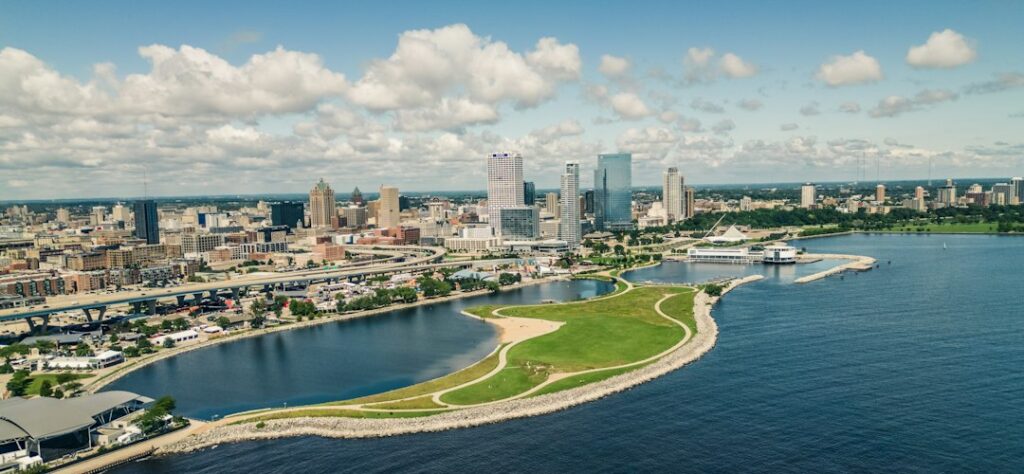
Milwaukee apartment neighborhoods fall into a few clear groups: a lakefront downtown of new high-rises, warehouse-loft districts just south of it, student-driven neighborhoods around UW-Milwaukee and Marquette, and a broad ring of older neighborhoods where most rental units sit in duplexes, Polish flats and small walk-ups. Each group has a different building type, a different renter and a different set of questions for an owner.
That variety reflects the city’s history as an industrial port that housed generations of immigrant workers close to their jobs. This guide moves through the main submarkets one at a time, using city planning documents, National Register records and the University of Wisconsin-Milwaukee’s Encyclopedia of Milwaukee, and closes with what the pattern means for someone who owns or is evaluating an apartment building in the city.
Milwaukee by the numbers
Milwaukee is the largest of the 19 municipalities in Milwaukee County. The 2020 census counted 577,222 residents, and the Census Bureau estimated 562,407 on July 1, 2025. It is a renter-majority city: Census QuickFacts for Milwaukee puts the owner-occupancy rate at 41.8% for 2020–2024, which means roughly 58% of households rent. Median gross rent over that period was $1,059, and the median value of an owner-occupied home was $184,000, with an average of 2.37 people per household.
Those citywide figures hide a wide spread. A new lakefront tower and a century-old two-flat on the north side can sit only a few miles apart while competing for entirely different tenants. That is why owners and buyers in Milwaukee tend to think in submarkets rather than citywide averages, and why the building type often tells you as much as the address.
The housing types that define Milwaukee’s rental stock
Before looking at neighborhoods, it helps to know the building types that recur across the city.
- The Polish flat. In the late 1800s, owners of small four-room frame cottages raised them on posts and built a brick semi-basement unit underneath, turning one home into a two-unit building. Some later built full two-story Polish flats from scratch. The Encyclopedia of Milwaukee’s entry on the Polish flat traces the form to roughly 1870–1920, when immigration created demand for cheap housing on the Polish South Side.
- The upper-lower duplex. Two stacked flats with separate entrances, built in large numbers in the early twentieth century. Many survive on the north and west sides, including brick Craftsman duplexes from the 1920s.
- The warehouse loft. Multi-story brick commercial and industrial buildings converted to apartments, concentrated in the Historic Third Ward and parts of Walker’s Point.
- The high-rise and mid-rise. Concrete, steel and, in one notable case, mass-timber towers built downtown and along the lakefront in the last decade.
The first two types are technically below the five-unit threshold, but they shape every apartment submarket around them, because they compete for the same renters and set the local rent baseline.
Downtown and East Town: the high-rise core
Downtown is where Milwaukee’s newest and tallest apartments are. Three buildings illustrate the range:
- The Couture at 909 E. Michigan Street is a 44-story lakefront tower with 322 apartments, built by Barrett Lo Visionary Development. Construction began in May 2021, leasing opened in January 2024, and the building includes a transit concourse served by the streetcar and bus rapid transit.
- 7Seventy7 at 777 N. Van Buren Street in East Town is a 34-story tower completed in 2018 with roughly 300 units, developed for Northwestern Mutual with Hines as development manager.
- Ascent, a 25-story, 259-unit building by New Land Enterprises, opened in 2022 as the world’s tallest mass-timber hybrid building at the time of its completion, at 284 feet.
Downtown’s anchor employer sits right next to these towers. Northwestern Mutual opened its 32-story, 1.1 million-square-foot Tower and Commons in August 2017 to house about 2,400 employees. That concentration of office workers within walking distance is a large part of why developers have built luxury rentals on the east side of downtown.
The city’s plan for the area points the same direction. The Common Council unanimously approved Connec+ing MKE: Downtown Plan 2040 on July 31, 2023, and the mayor signed it that August. The first of its six “big ideas” is growing downtown’s residential population, and its catalytic projects include extending the streetcar toward Westown, Bronzeville, Walker’s Point and the East Side.
Development has also spread northwest of the core toward the Deer District around the Bucks’ arena. In February 2025, a Common Council committee approved a roughly $100 million, seven-story project on the district’s Block 5 with 269 apartments and a fieldhouse for Milwaukee Area Technical College; as of that reporting it was a planned project rather than a finished one.
The streetcar as a submarket boundary
Since September 1, 2026, The Hop has run as two routes. The M-Line runs 2.1 miles from the Milwaukee Intermodal Station through downtown, the Third Ward and East Town to Burns Commons, and the L-Line connects the Third Ward and downtown to the lakefront extension that opened in 2024. Service is free, and July 2026 ridership was 65,382. For renters without a car, proximity to the line is a real amenity, and buildings along it often market it.
South of downtown: lofts, old blocks and the harbor
The neighborhoods directly south of downtown share an industrial past but offer very different apartment stock today.
The Historic Third Ward
Just south of downtown along the Milwaukee River, the Historic Third Ward is the city’s loft district. According to its National Register listing, the district was listed on March 8, 1984, covers 12 blocks, and contains 71 contributing buildings, mostly multi-story brick warehouses built between 1892 and 1928 after a fire destroyed much of the area in 1892.
Those wholesale and manufacturing buildings became the raw material for loft apartments and condominiums. The features that made them good warehouses, such as solid brick construction, high ceilings and large windows, are the same ones loft renters pay for. The tradeoff for owners is that historic status shapes what can be changed on the exterior, and older building systems can be expensive to maintain. The Third Ward is also on the M-Line, linking it to downtown jobs without a car.
Walker’s Point and the Harbor District
Walker’s Point, about a mile south of the original downtown, is one of the city’s oldest neighborhoods. Its historic district record shows a listing on December 19, 1978, with 480 contributing buildings built between 1834 and 1910, including about 290 working-class homes, often Greek Revival or Italianate, plus commercial blocks. The result is a fine-grained mix of small homes, corner commercial buildings and former industrial space, with newer apartment buildings filling in between.
East and south of Walker’s Point is the Harbor District, the industrial land along the inner harbor. The Common Council adopted the Harbor District Water and Land Use Plan on February 6, 2018, setting a framework for redeveloping former industrial sites. The most visible project so far is Komatsu’s headquarters campus: in September 2018 the company announced a $285 million complex on the 47-acre former Solvay Coke site, south of Greenfield Avenue and east of 1st Street. For apartment owners, the significance is that a large employer has committed to an area that was long off limits to housing demand.
Lower East Side, Brady Street and the UWM corridor
North of downtown, the East Side runs along the lakefront toward the University of Wisconsin-Milwaukee. The East Brady Street Historic District, listed on the National Register on March 9, 1990, covers Brady Street from Farwell Avenue to Van Buren Street. It began as a Polish commercial center in the 1870s and mixes workers’ cottages, commercial blocks and St. Hedwig’s Church, with 74 contributing buildings dating from 1875 to 1931.
Farther north, demand is shaped by UWM. Preliminary figures published by the university in September 2026 show fall 2026 UWM enrollment of 22,662 students, including 18,897 undergraduates and 3,768 graduate students, and a first-year class of 3,903, the largest in 17 years. A larger entering class matters for nearby landlords, because many students who start in residence halls move into the surrounding neighborhoods in later years.
Riverwest: flats, students and artists
Riverwest sits across the Milwaukee River from the East Side, bounded by the river to the east and south, Holton Street to the west and Capitol Drive to the north. The Encyclopedia of Milwaukee’s history of Riverwest describes a Polish settlement centered on St. Hedwig Parish, founded in 1871, with housing made up of single-family homes and duplexes, many with Polish-flat basement units added for rental income. Students moved in for inexpensive housing close to UWM, and an artist community grew there in the 1970s.
For an apartment owner, Riverwest is a small-building market. Larger apartment buildings are the exception, and the dominant competition is the duplex and the converted flat, often owned by individuals. Renters here tend to value character and location over amenities.
Bay View: puddlers’ cottages on the south shore
Bay View, on the lakefront south of downtown, grew around the Milwaukee Iron Company rolling mill, which opened in the late 1860s. Its founder, Eber Brock Ward, built a company town around the mill with 88 houses by 1870. The surviving “puddlers’ cottages,” named for the ironworkers who lived in them, are small one-story homes without basements; the longest remaining row is on the 2500 block of South Superior Street.
Bay View’s housing stock today mixes those cottages with bungalows, duplexes and small apartment buildings along its commercial corridors. It is a good example of a Milwaukee neighborhood where the apartment market is made up of many small buildings rather than a few large ones, and where neighborhood character, not new construction, is the draw.
Avenues West, Washington Heights and Sherman Park
West of downtown, Avenues West runs from 11th to 27th streets and from Highland Avenue to Clybourn Street, next to Marquette University. Grand Avenue mansions from the 1870s were later divided into apartments, and student housing has grown alongside the campus. Marquette’s official fall 2025 count was 8,206 undergraduates and 3,705 graduate and professional students, or about 11,900 in total, which gives the area a steady student renter base.
Farther west are two neighborhoods dominated by early twentieth-century duplexes. Washington Heights, bounded by Highway 175, North Avenue, 60th Street and Vliet Street, is mostly 1920s housing: Arts and Crafts bungalows and large duplexes, bordering Wauwatosa. Sherman Park is known for brick Craftsman duplexes along Sherman Boulevard; one example, the Himmelstein Duplex at 2851–53 N. Sherman Boulevard, was built in 1923–24. Both neighborhoods have relatively few large apartment buildings, but their duplex stock sets the rent expectations that any nearby multifamily building has to meet.
Some of the region’s largest employers sit just outside the city line. Froedtert Hospital and the Medical College of Wisconsin share the Milwaukee Regional Medical Center campus near 92nd Street and Wisconsin Avenue, which is in Wauwatosa even though it uses a Milwaukee mailing address. Froedtert has had an academic partnership with the medical college since 1980 and operates the only adult Level I trauma center in eastern Wisconsin. Health care workers commuting to that campus are part of the renter pool on Milwaukee’s west side.
Questions to ask in each type of submarket
Because the submarkets differ so much, the due-diligence questions differ too. A few examples of what an owner or buyer might focus on in each:
Downtown and lakefront towers
How much new supply is leasing nearby, and is it offering concessions? Buildings like The Couture and Ascent set the top of the market, so an older downtown building needs a clear price or location advantage. Distance to the M-Line or L-Line and to large employers such as Northwestern Mutual is a practical selling point worth measuring, not assuming.
Loft and historic districts
Is the building a contributing structure in a National Register district, and what does that mean for exterior work, windows and signage? How old are the elevator, roof, masonry and mechanical systems? In the Third Ward and Walker’s Point, the brick and timber that attract renters also drive capital spending.
Student-driven neighborhoods
When do leases start and end? Near UWM and Marquette, many leases follow the academic calendar, which concentrates turnover in a few weeks each year. Turnover cost, furnished versus unfurnished units, and parental guarantees are typical underwriting items here.
Duplex-heavy neighborhoods
What do comparable upper and lower flats rent for on the surrounding blocks? In Riverwest, Bay View, Washington Heights and Sherman Park, a small apartment building’s real competition is often an owner-occupied duplex whose owner rents the other unit, and that sets a practical ceiling on rents.
What Milwaukee apartment neighborhoods mean for owners
The neighborhood map translates into a few practical lessons:
- Building type drives the business. A downtown tower competes on amenities and transit; a Riverwest or Sherman Park building competes with duplexes owned by individuals. Underwriting should start with the competing stock, not the citywide median rent.
- Institutions anchor demand. UWM’s growing first-year class and Marquette’s roughly 11,900 students support the East Side, Riverwest and Avenues West, while Northwestern Mutual and other downtown employers support East Town.
- Historic districts cut both ways. Third Ward, Walker’s Point and Brady Street buildings carry character renters pay for, along with exterior-change limits and older systems.
- Planning signals where growth goes. The Downtown Plan 2040 and the Harbor District plan point new housing toward downtown, the streetcar corridors and the inner harbor.
Because building type, age and location vary so much from one neighborhood to the next, a single citywide capitalization rate rarely fits a specific property. Running a building’s own income and expenses through an apartment building value calculator is a better starting point than a citywide rule of thumb. For context beyond the city, see our Wisconsin market overview, and for local buyer activity and values, visit our Milwaukee market page.