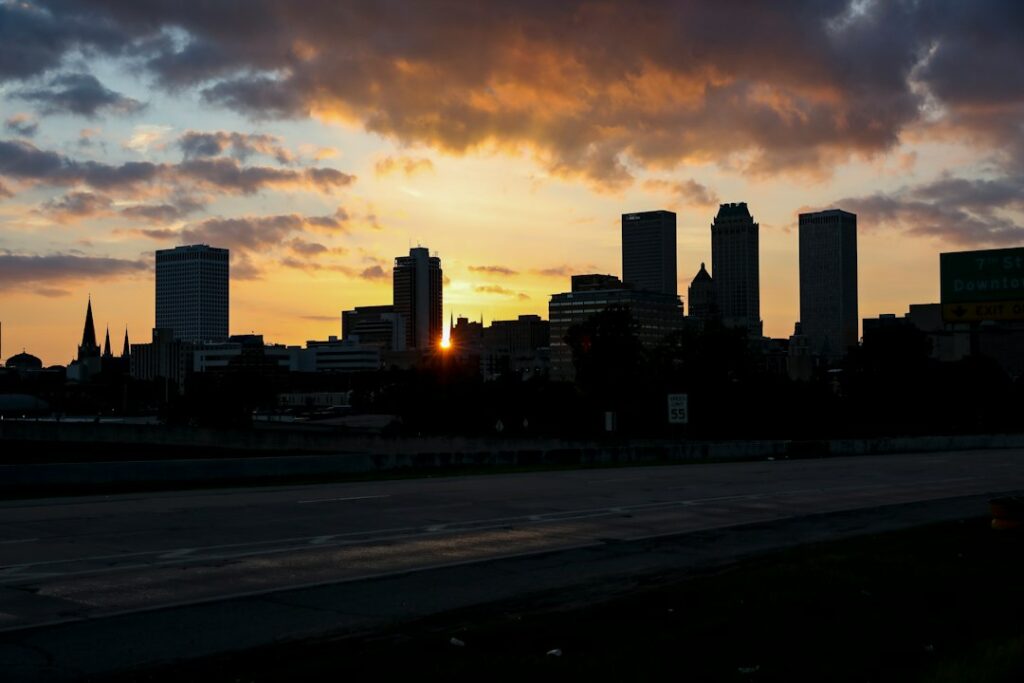
Tulsa apartment demand rests on three things: a city where nearly half of households rent, an employment base anchored by large hospital systems, aviation maintenance and energy headquarters, and a steady inflow of newcomers, including more than 4,000 remote workers recruited since 2018. The city’s own 2023 housing assessment adds a fourth factor, a shortfall of nearly 13,000 housing units over ten years, which keeps pressure on the existing rental stock even while job growth runs at a modest pace.
None of those drivers is new, but together they explain why Tulsa behaves differently from faster-growing Sun Belt metros. Population growth is slow inside the city and faster in the county; jobs are concentrated in sectors that are less cyclical than oil itself; and the biggest constraint on renters is affordability rather than a lack of buildings to choose from. The sections below go through each driver with the most recent official figures available.
A renter-heavy city inside a growing county
The City of Tulsa, the seat of Tulsa County and Oklahoma’s second-largest city, counted 413,066 residents at the 2020 Census. The Census Bureau’s QuickFacts profile for Tulsa estimates 416,209 residents as of July 1, 2025, growth of less than 1% in five years.
The county is growing faster. Tulsa County counted 669,279 residents in 2020 and an estimated 698,782 in July 2025, a 4.4% increase measured from the Census Bureau’s estimates base. The county held 305,881 housing units in 2025. In other words, most of the region’s added residents over the past five years settled in the suburbs and unincorporated areas rather than inside the city limits.
HUD’s 2023 market analysis gives the wider metro view. It estimated the metro area’s population at about 1.04 million, growing roughly 0.8% a year, and forecast household growth of about 4,025 households a year, or 1.0%, over its three-year forecast period. Households matter more than people for apartment demand, because each new household needs a unit, and household growth running ahead of population growth reflects smaller household sizes as well as new arrivals. For owners inside the city, the practical question is how much of that household growth chooses an apartment in Tulsa proper rather than a newer house in Broken Arrow, Owasso, Jenks or Bixby.
Tenure is where the city stands out. QuickFacts reports an owner-occupied housing rate of 51.9% in the city for 2020–2024, which implies that about 48% of occupied homes are rented. In the county as a whole, the owner rate is 59.7%, implying roughly 40% renters. For an apartment owner, that gap is the core of the urban rental market: the city holds a disproportionate share of the county’s renter households, and the apartment buildings inside the city limits are where many of them live.
Healthcare is the largest employer base
Hospitals are the single largest source of jobs in the region. Saint Francis Health System describes itself as the region’s largest private employer, with more than 12,000 employees, and says its main hospital, licensed for 1,112 beds, is Oklahoma’s largest.
HUD’s 2023 Comprehensive Housing Market Analysis for the Tulsa area lists the region’s largest employers as of May 2023 (excluding local school districts):
- Saint Francis Health System, 10,000 employees
- Walmart, 7,300
- St. John Health System, 7,000
- Hillcrest HealthCare, 6,500
- American Airlines, 4,800
- City of Tulsa, 3,600
- Macy’s, 3,500
- Amazon, 3,000
- BOK Financial, 2,700
- Tulsa County Government, 1,900
Three of the top four are hospital systems. Healthcare employment matters for apartment demand in a specific way: hospitals run around the clock, employ large numbers of nurses, technicians and support staff on shift schedules, and tend to hire steadily through economic cycles. Apartments within a short drive of the major medical campuses benefit from a renter pool that turns over as staff rotate in and out but does not disappear in a downturn.
Aviation, energy headquarters and finance
American Airlines’ maintenance base
Tulsa is home to a major American Airlines maintenance base. When the airline announced a $550 million investment in 2020, it described the base as covering 3.3 million square feet on 330 acres, with more than 5,500 staff, and noted it had added 600 workers in 2019. HUD’s 2023 count of 4,800 employees shows the headcount moves with the airline’s needs, so the precise number changes year to year. What does not change is that the base employs thousands of skilled mechanics and technicians, a workforce with steady wages that supports rental demand in the neighborhoods within commuting distance of Tulsa International Airport.
Fortune 500 headquarters
The Oklahoma Department of Commerce’s review of the 2025 Fortune 500 list shows two Tulsa-headquartered companies: ONEOK at No. 200, the highest-ranked Oklahoma company, and Williams at No. 404. Both are midstream energy companies that move and process oil and gas rather than drill for it. Corporate headquarters bring professional and executive jobs concentrated downtown, which supports demand for the newer and renovated apartments in and around the central business district.
Finance
BOK Financial, with 2,700 employees on HUD’s 2023 list, rounds out the white-collar base. Together with the energy headquarters, it gives downtown Tulsa a professional workforce that can support higher-rent apartments close to the office core.
The pace of job growth
The headline employment numbers show stability rather than a boom. The Bureau of Labor Statistics’ economy-at-a-glance page for the Tulsa metro reports 482,300 nonfarm jobs and a 4.1% unemployment rate in August 2026 (preliminary), with employment up 0.3% from a year earlier. The largest supersectors are trade, transportation and utilities, with 86,500 jobs, and education and health services, with 85,400.
For apartment owners, slow job growth cuts both ways. It limits the kind of rapid rent increases seen in metros adding tens of thousands of jobs a year, but it also means new construction has to be justified by steady rather than explosive demand. The healthcare-heavy job base adds a measure of stability that a single-industry economy would not.
Tulsa Remote and the newcomer pipeline
Tulsa has an unusual demand source: a program that pays people to move there. Tulsa Remote offers a $10,000 incentive to remote workers who relocate to the city. According to reporting by the Tulsa Flyer in April 2026, the program has now brought 4,000 people to Tulsa since 2018, including about 500 arrivals in 2025, with about 550 more planned for 2026. The program reports that 70% of participants continue to live in Tulsa. The pace has picked up over time: in 2022, local reporting marked the program’s 2,000th participant, so the second 2,000 arrived in roughly four years.
Newcomers to a city usually rent before they buy, especially when they are still learning neighborhoods, so a steady stream of several hundred arrivals a year flows straight into the rental market. The program reports that participants have added more than $878 million to the local economy; that is the program’s own estimate rather than an independent figure, but the arrival counts themselves are straightforward.
Quality of life as part of the pitch
Tulsa’s recruitment of newcomers leans on amenities that a city of its size does not always have. Gathering Place, a roughly 66-acre riverfront park that opened on September 8, 2018, was built with $465 million in private funding from the George Kaiser Family Foundation. Amenities like the park give Tulsa a pitch to remote workers and young professionals that rests on lifestyle as much as on cost, and they are part of how programs like Tulsa Remote persuade people to choose Tulsa over other mid-sized cities with similar living costs.
The federal Tech Hub designation
In fall 2023 the federal Economic Development Administration named Tulsa one of its Regional Technology and Innovation Hubs, and in July 2024 the region was one of 12 hubs selected for implementation funding. The University of Tulsa’s announcement of the roughly $51 million award describes the Tulsa Hub for Equitable and Trustworthy Autonomy, led by Tulsa Innovation Labs, which focuses on autonomous systems.
The announcement states a goal of creating up to 56,000 new jobs over the next decade. That is an aspiration, not a forecast, and it is best read as a statement of direction: federal money is being spent to build an engineering and technology cluster in Tulsa, which over time would add higher-wage renters to a market that has historically leaned on healthcare, aviation and energy.
Students and young renters
Tulsa’s college population is smaller than in a typical university town, but it adds a meaningful layer of renters. Tulsa Community College’s preliminary fall 2025 report counts 16,668 students, and TCC notes that its metro enrollment figures include students at OSU-Tulsa. Community college students are more likely to work and live off campus than residential university students, so most of that enrollment shows up in the general rental market rather than in dormitories.
Rents, incomes and vacancy
Census data gives a long-run baseline for what Tulsa renters pay. The 2020–2024 American Community Survey puts median gross rent at $1,052 in the city and $1,110 in the county. Median household income for all households was $59,838 in the city and $69,009 in the county, in 2024 dollars. Twelve months of the city’s median rent works out to about 21% of the city’s median household income, though renter households typically earn less than the overall median, so the burden for renters is higher than that simple ratio suggests.
The city’s 2023 Citywide Housing Assessment, as reported by News 9 and in the City’s own statements, found that 46% of Tulsa renters spend more than 30% of their income on housing. That is the standard threshold for being cost burdened, and it is the clearest signal that Tulsa’s rental market is constrained by what renters can pay more than by any shortage of tenants.
HUD’s 2023 market analysis for the Tulsa area, which covers the whole metro area as of May 1, 2023, described the rental market as balanced, with an overall rental vacancy rate of 8.5% and apartment vacancy of 7.1% in the first quarter of 2023, up from 5.1% a year earlier, as newly built units leased up. The average apartment rent was $931, up 3% from the year before. HUD forecast demand for 3,900 new rental units between May 2023 and May 2026, compared with 2,700 then under construction. Those figures are now more than three years old and the forecast window has closed, so they are useful mainly as a benchmark for comparing current private-market data.
A documented housing shortfall
The strongest structural support for Tulsa’s rental demand is a supply gap that the city itself has quantified. According to the City of Tulsa, the 2023 Citywide Housing Assessment found that Tulsa needed almost 13,000 more housing units over the following ten years, more than 6,000 of them for low-income residents.
The city has set targets and funding to close part of that gap:
- The mayor’s affordable housing goal. Mayor Monroe Nichols has set a goal of 6,000 affordable units by 2028, paired with a 60% reduction in blighted properties. In a June 2026 city release proclaiming Housing Month, the city reported more than 1,800 affordable units completed or permitted since December 2024.
- Bond money for housing. Voters approved the Improve Our Tulsa 3 capital package in August 2023, which dedicated $75 million to housing. The Tulsa Housing Impact Fund was selected to administer $47 million of that amount.
- Kirkpatrick Heights and Greenwood. City Council unanimously approved a master plan in December 2022 for 56 acres of city and Tulsa Development Authority land in North Tulsa, with the core of the site planned for mixed-use and residential development. The city committed $2 million from its fiscal 2023 budget and $5 million from Improve Our Tulsa to early implementation, and site work for the planned Greenwood Plaza was projected at $14 million to $22 million. No unit count has been published, so the project is best treated as a long-term addition to North Tulsa’s housing supply rather than a near-term competitor.
The waitlist at the Tulsa Housing Authority shows how much demand sits below market-rate rents. News 9 reported in September 2024 that more than 9,000 applicants were waiting for Section 8 vouchers and the authority’s River West development, with waits of about two years. For owners who accept vouchers, that waitlist represents a deep pool of qualified applicants, and voucher holders who do receive assistance need units to lease.
New affordable production is aimed at the lowest income bands, which means it competes most directly with older, lower-rent apartments rather than with newer market-rate buildings. Owners of Class C properties should watch where subsidized deliveries land, while owners of mid-priced Class B buildings face less direct competition from that pipeline.
What Tulsa apartment demand means for owners
Pulling the drivers together gives a clear picture of where demand is strongest and what could change it:
- Medical and shift workers support steady demand near the major hospital campuses, with turnover but low risk of a sudden collapse in renters.
- Aviation and energy professionals support demand near the airport and downtown, and their employers’ investment decisions are the main swing factor.
- Newcomers through Tulsa Remote add several hundred arrivals a year, many of whom rent while they learn the city.
- Lower-income renters form the largest and most cost-burdened group, which makes affordability, not tenant supply, the limit on rents in older buildings.
- New affordable supply funded by the city and the housing bond will mostly compete with older, lower-rent stock.
Investors evaluating Tulsa from a distance often focus on the energy sector, but the employment data points elsewhere: healthcare and aviation account for more of the region’s largest employers than oil and gas production. For passive investors, our overview of how passive multifamily investing works explains how operators turn these local demand factors into an underwriting view. Owners can also compare Tulsa with other cities on our Oklahoma markets page, or read more about local conditions on our Tulsa market page.