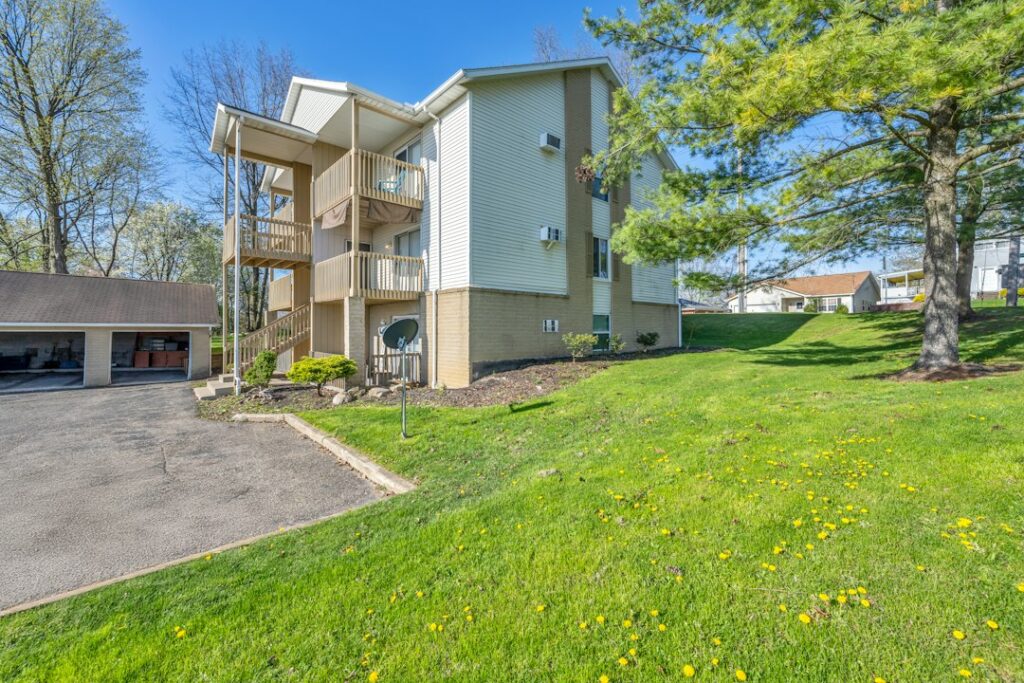
Trenton apartment property taxes are calculated by multiplying a building’s assessed value by the city’s general tax rate, which the Mercer County Board of Taxation set at 6.201 per $100 of assessed value for 2026. Because Trenton last revalued in 2017 and its assessments now sit at roughly half of market value, the number that matters most for an apartment owner is not the rate alone but how the assessment compares with what the building is actually worth.
This guide walks through how New Jersey classifies and assesses apartment buildings, how Trenton’s rate is built, what the equalization ratio and the Chapter 123 range mean for appeals, how the income request known as Chapter 91 works, and which abatement programs can change a tax bill. It uses figures published by the Mercer County Board of Taxation, the New Jersey Division of Taxation and the state statutes.
Trenton’s rental market and tax base in brief
Trenton is New Jersey’s capital and the seat of Mercer County. The Census Bureau’s QuickFacts profile for Trenton estimates 91,506 residents on July 1, 2025, compared with 90,871 in the 2020 Census. The city is majority renter: the owner-occupied rate for 2020 to 2024 was 37.9%, so about 62% of its 32,052 households rent. Median gross rent over the same period was $1,294, and 21.6% of residents lived in poverty.
The city’s tax base is unusual. In Mercer County’s 2025 abstract of ratables, Trenton’s exempt property was assessed at about $2.80 billion, more than its roughly $2.23 billion of taxable land and improvements. Exempt property therefore made up about 56% of all assessed value in the city. Public property alone, a category that includes state, county and city holdings, accounted for about $1.88 billion, or roughly 37% of the total. The Trenton Board of Education’s 2025 annual financial report notes that a significant portion of land and buildings is tax-exempt because of its use by the State of New Jersey.
For apartment owners, that means a relatively small taxable base carries the cost of city services and schools. It is one reason Trenton’s general tax rate is high, and why small errors in an assessment translate into large dollar amounts.
How New Jersey classifies apartment buildings
New Jersey sorts every parcel into a property class. Buildings with one to four units are generally in the residential class, while larger apartment buildings fall in Class 4C. The state regulation, N.J.A.C. 18:12-2.2(g), defines Class 4C as apartments designed for the use and enjoyment of five families or more, including residential cooperatives and mutual housing corporations.
The class matters for three reasons:
- Valuation method. Assessors and appraisers usually value Class 4C buildings as income-producing property, giving weight to rents, vacancy and operating expenses rather than only to comparable sales.
- Information requests. Income-producing properties are subject to the Chapter 91 income request described below.
- Reporting. Class 4A commercial, 4B industrial and 4C apartment properties are listed separately on the tax list but grouped together as Class 4 in the state’s equalization tables.
Trenton’s 2026 tax rate, piece by piece
The Mercer County Board of Taxation’s tax rate tables break the 2026 general tax rate of 6.201 per $100 of assessed value into its parts:
- Municipal purpose: 3.908
- School: 1.195
- County: 0.978
- Municipal library: 0.063
- County open space: 0.057
The municipal share is the largest piece by far, more than three times the school share. The rate has risen in recent years. The state’s rate history shows Trenton’s general rate at 5.567 in 2023, 5.801 in 2024 and 5.890 in 2025, so the 2026 figure is about 5.3% higher than the year before.
A worked example
The bill is assessed value divided by 100, multiplied by the general rate. A building assessed at $1,000,000 in 2026 would owe about $62,010 in property taxes for the year. A building assessed at $2,000,000 would owe about $124,020.
General rate versus effective rate
New Jersey publishes two rates for every municipality. The Division of Taxation’s explanation of property tax statistics says the general tax rate is the rate used to compute the tax bill, while the effective tax rate is a statistical measure that allows one district to be compared with another and is not to be used to compute a bill. The county’s 2026 abstract lists Trenton’s effective rate at 3.246. Owners comparing Trenton with other New Jersey towns should compare effective rates; owners estimating their own bill should use the general rate and their assessment.
The equalization ratio and why it matters
Trenton’s assessments are based on a revaluation completed for tax year 2017, with values as of October 1, 2016. Trenton appears on the state’s list of approved revaluations for 2017 and not on the lists for 2018 through 2026. Since then, market values have risen while assessments have mostly stayed put.
The state measures that gap each year with the director’s equalization ratio, which compares total assessed value with estimated true market value. For tax year 2026, Trenton’s ratio is 53.53%, as amended by the Tax Court in January 2026. The 2026 table lists Trenton’s real property assessed at about $2.20 billion against an equalized true value of about $4.34 billion. The table certified October 1, 2026 for tax year 2027 lowers the ratio further, to 50.66%.
In plain terms, the average Trenton property is assessed at about half of what the state believes it would sell for. That is not unfair by itself, because every property is supposed to be assessed at the same fraction. The issue arises when a particular building is assessed at a higher fraction of its value than the city average.
Chapter 123: the range that shapes appeals
New Jersey’s Chapter 123 sets a common level range for each municipality, equal to the average ratio plus or minus 15%. The state’s Chapter 123 common level range table for 2026 puts Trenton’s range at 45.50% to 61.56%. For tax year 2027, the range is 43.06% to 58.26%.
Here is how it works in an appeal. The owner, or the owner’s appraiser, establishes the building’s true market value. The assessment is then divided by that value to find the building’s own ratio.
- Inside the range: If the ratio falls between the lower and upper limits, the assessment generally stands, even if the owner believes it is a little high.
- Above the range: If the ratio is higher than the upper limit, the assessment is reduced by applying the average ratio to the market value.
- Below the range: If the ratio is under the lower limit, the assessment can be increased the same way.
An appeal example
Suppose a Trenton apartment building is assessed at $2,000,000 for 2026 and an appraisal supports a market value of $3,000,000. The building’s ratio is about 66.7%, above the 61.56% upper limit. Applying the 53.53% average ratio to the $3,000,000 value gives a revised assessment of $1,605,900. At the 6.201 rate, the bill would fall from about $124,020 to about $99,582, a difference of more than $24,000 a year.
The same math cuts the other way. An owner whose assessment is already inside the range should expect little or no relief, and an aggressive appeal on an under-assessed building can invite a counterclaim.
Chapter 91 income requests
Under N.J.S.A. 54:4-34, often called Chapter 91, the assessor may send an owner of income-producing property a written request, by certified mail, for a full and true account of the income from the property. The request must include a copy of the statute. The key rule is in the text of the statute published by the New Jersey Legislature: no appeal will be heard from the assessor’s valuation where the owner has failed or refused to respond within 45 days of the request.
For apartment owners, that makes a Chapter 91 letter one of the most important pieces of mail of the year. Practical steps:
- Keep annual operating statements and rent rolls current so a response can be assembled quickly.
- Calendar 45 days from receipt of any certified letter from the assessor.
- Answer completely, even when no appeal is planned, to preserve the right to appeal later.
- Keep proof of the date and method of the response.
Deadlines, appeals and payment dates
Appeal deadlines
Under the state’s Form A-1 petition of appeal instructions, an appeal must be received, not just postmarked, on or before April 1 of the tax year, or within 45 days after the bulk mailing of assessment notices is completed, whichever is later. In a municipality that has just completed a municipal-wide revaluation or reassessment, the deadline is May 1. The Mercer County Board of Taxation lists April 1, 2027 as the next deadline. Trenton’s own guidance says assessment notices are mailed on or about February 1, and that an added assessment billed in October can be appealed by December 1 of that year.
Where to file
Any owner may file with the Mercer County Board of Taxation, located at 640 South Broad Street in Trenton. Owners of property assessed above $1,000,000 may file directly with the New Jersey Tax Court instead. A county board judgment can be appealed to the Tax Court within 45 days. For added or omitted assessments, the threshold for filing directly with the Tax Court is $750,000.
Quarterly payments
Under N.J.S.A. 54:4-66, property taxes are payable in quarterly installments due February 1, May 1, August 1 and November 1, and become delinquent after those dates. Owners who escrow taxes through a lender should still confirm each payment posts on time, since interest begins once an installment is delinquent.
Abatements and PILOT agreements
Two state laws allow New Jersey municipalities to reduce or replace taxes on qualifying projects.
Five-Year Exemption and Abatement Law
The Five-Year Exemption and Abatement Law, N.J.S.A. 40A:21, lets a municipality treat the value of improvements or conversions to multiple dwellings as not increasing the property’s assessed value for five years, or grant a five-year abatement. Each year’s abatement is capped at 30% of the improvement cost. The program applies only in areas the municipality has designated as in need of rehabilitation and only where it has adopted an enabling ordinance, so owners should confirm with the city whether a property qualifies before budgeting for it.
Long Term Tax Exemption Law
The Long Term Tax Exemption Law, N.J.S.A. 40A:20, allows a project to pay an annual service charge instead of conventional taxes under a financial agreement, often called a PILOT. For most projects the charge is at least 10% of annual gross revenue, with a cap of 15% for low- and moderate-income housing, or alternatively 2% of total project cost, and it steps up in stages over the term. Assessments set under these agreements cannot be challenged through the normal appeal process.
Trenton uses these agreements. The city code’s disposition list includes several 2014 ordinances titled tax abatement and financial agreement, such as Ordinances 14-15, 14-16 and 14-27. For a buyer, a PILOT on a building can change the expense line dramatically, and the agreement’s terms, transferability and step-up schedule need close review.
What Trenton apartment property taxes mean for owners
Taken together, the rules point to a few habits that protect net operating income:
- Check your ratio every year. Divide your assessment by a realistic market value and compare the result with the Chapter 123 range for that tax year. With the 2027 range falling to 43.06% to 58.26%, some buildings that were inside the range in 2026 may fall above it in 2027.
- Answer every Chapter 91 letter. Missing the 45-day window can forfeit the right to appeal for that year.
- Budget for rate increases. The general rate rose in each of the last three years. Underwrite with a cushion rather than the current bill.
- Plan for a revaluation. Trenton’s ratio is well below 100%, and the gap has been widening. A future revaluation would reset assessments closer to market value, and the rate would be recalculated, so the effect on any one building depends on how its value compares with the city average.
- Read abatement agreements closely. A building with a PILOT or a five-year abatement carries a different tax profile from its neighbors, and that profile can change on a schedule.
New Jersey’s statewide rules on rent and property taxes are summarized in our guide to rent control and property tax by state. The state’s guide to landlord-tenant law also notes that New Jersey has no statewide rent control, and that new multiple dwellings are exempt from local rent control for 30 years under N.J.S.A. 2A:42-84.5.
Where Trenton fits among New Jersey markets
Trenton combines a high general rate with low assessment ratios, a narrow taxable base and a large renter population. That makes property tax the expense line most worth managing actively. Owners comparing Trenton with other cities in the state can start on our New Jersey markets page, and those weighing a sale can learn more about selling an apartment building in Trenton on our city page.
The simplest rule for a Trenton owner: when an assessment notice arrives each February, compare it with the current Chapter 123 range before the April 1 deadline. That single check, repeated every year, catches over-assessments before they compound into years of overpaid taxes.