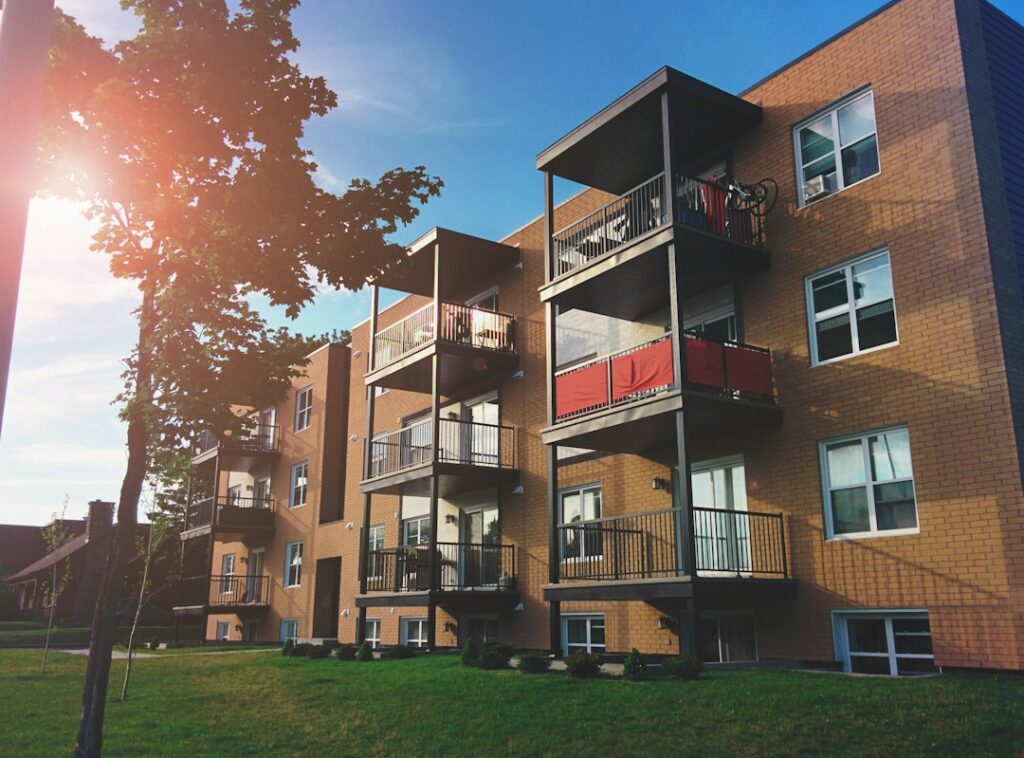
Bismarck apartment property taxes are calculated on a commercial basis whenever a building has four or more units: North Dakota taxes those buildings on 5% of their true and full value, and that taxable value is multiplied by the local mill levy, which totaled 237.10 mills in Bismarck’s main taxing district for the 2025 tax year. In practice, that works out to roughly 1.19% of market value per year, compared with about 1.07% for a house or duplex at the same levy.
The rest of this article explains how each piece of that formula is set, who sets it, when bills arrive, how owners can challenge a value, and what the state’s 2025 property tax reforms do and do not change for rental buildings in North Dakota’s capital city. Bismarck, in Burleigh County, counted 73,622 residents at the 2020 Census and an estimated 75,092 in 2023, with an owner-occupancy rate of 65.8% in the 2019–2023 American Community Survey, which leaves about a third of households renting.
Why Bismarck apartment property taxes follow commercial rules
North Dakota sorts real property into classes, and the class determines what share of value is taxed. The North Dakota Century Code, chapter 57-02, defines residential property in section 57-02-01(14), but that definition specifically excludes “structures providing living accommodations for four or more separate family units.” Anything that does not fit another class is commercial under section 57-02-01(5).
The State Tax Commissioner’s guideline on residential and commercial property states the result plainly: an apartment building or other building with four or more family living units is classified as commercial property. Three practical consequences follow:
- A fourplex and a 40-unit complex are taxed in the same class, as commercial property.
- Duplexes and triplexes remain residential and are taxed on the lower residential percentage.
- A building with both residential and non-residential uses, such as apartments over ground-floor retail, has its value prorated between classes under section 57-02-27(1)(a).
The same rule sweeps in tracts with four or more mobile homes, which are also excluded from the residential definition.
From market value to tax bill
North Dakota builds a property tax bill in three steps, all set out in chapter 57-02:
- True and full value is the assessor’s estimate of market value.
- Assessed value is 50% of true and full value, under section 57-02-01(3).
- Taxable value is 9% of assessed value for residential property and 10% for commercial property, under section 57-02-27(1).
The tax is then taxable value multiplied by the consolidated mill levy, where one mill equals one-thousandth of a dollar. Put together, residential property is taxed on 4.5% of market value and commercial property, including apartment buildings of four or more units, on 5%.
A worked example
The City of Bismarck’s assessing FAQ walks through the arithmetic, and the Assessing Division’s 2026 annual report shows a $200,000 commercial property paying about $2,371 at the 2025 levy, against about $2,134 for a $200,000 residential property. Scaling the same math to a typical small apartment building:
- A 16-unit building valued at $2,000,000 has an assessed value of $1,000,000 and a taxable value of $100,000.
- At 237.10 mills, the tax is $100,000 × 0.23710 = $23,710 a year, or about $1,482 per unit.
- A triplex valued at $600,000 is residential: $300,000 assessed, $27,000 taxable, and about $6,402 in tax.
That 10% versus 9% difference means a four-unit building pays about 11% more tax than a triplex of identical value, a detail worth knowing before adding a unit to a three-unit property.
Who sets the value and when
Valuation in Bismarck is done by the City of Bismarck Assessing Division, which uses certified appraisers and data-collection staff who inspect properties. Under section 57-02-11(1), values are set as of February 1 each year, the statutory assessment date.
The city says it follows the Tax Commissioner’s guidance, the Century Code, and nationally recognized mass appraisal standards. For rental property, the state’s guideline describes the three standard appraisal approaches (cost, sales comparison and income capitalization) along with gross rent and gross income multipliers. For apartment owners, the income approach is the one to understand: when rents rise and operating expenses hold steady, an income-based value tends to rise with them, and when a building’s actual income lags the market, documenting that gap is the owner’s strongest argument for a lower value.
The 2025 mill levy, piece by piece
Burleigh County’s 2025 mill levy sheet shows a total of 237.10 mills for Bismarck’s main taxing district (district 01/01/01). It breaks down as:
- City of Bismarck: 76.38 mills.
- Bismarck Public Schools District #1: 106.46 mills.
- Bismarck Park District: 32.09 mills.
- County, state and other levies combined: 22.17 mills.
The school district accounts for about 45% of the total, the city for about a third, and the park district for roughly 14%. Properties in other taxing districts within the city may carry slightly different totals, so the district code on the tax statement is the reference for any specific building. Levies are set every year, and the 2025 total of 237.10 mills compares with 259.90 mills in 2023, the figure the city’s older examples still use.
What the 2026 assessment roll shows
The Assessing Division’s 2026 annual report gives a snapshot of the city’s tax base:
- Total market value of $12,068,139,100, up 4.44% from the prior year.
- Commercial market value of $4,246,213,600 and residential market value of $7,821,300,600.
- Total taxable value of $564,300,452.
- 27,821 parcels, of which 3,352 are commercial.
Because apartment buildings of four or more units are commercial, they sit inside that $4.2 billion commercial figure alongside offices, retail and industrial property. A 4.44% citywide increase in market value does not automatically mean a 4.44% increase in tax, because levies can be adjusted, but owners should expect assessment notices to track broad market movement.
To see the sensitivity, take the same $2,000,000 building from the example above. If its value rose by the citywide average of 4.44% to about $2,088,800, its taxable value would rise by $4,440, and at an unchanged 237.10 mills its tax would rise by about $1,053 a year. Whether that increase actually shows up on the bill depends on what happens to the levy, which is where the 2025 reforms described below come in.
Statements, discounts and due dates
Burleigh County bills and collects the tax. According to the county’s tax statement page:
- Real estate tax statements are mailed in December and must be mailed by December 26.
- Paying the full year’s tax by February 15 earns a 5% discount.
- Owners who pay in installments owe the first half by March 1 and the second half by October 15.
Late payments carry escalating penalties. On the first installment, the penalty is 3% on March 2, rising to 6% on May 1, 9% on July 1 and 12% on October 15. The second installment carries a 6% penalty from October 16. On the $23,710 bill from the example above, a first installment of $11,855 left unpaid until October 15 would carry a 12% penalty of about $1,423. On the other side of the ledger, paying that same bill in full by February 15 would save about $1,186, a discount worth planning cash flow around.
Challenging a value: notices, boards and abatement
North Dakota’s appeal process runs on a fixed calendar, and missing a step can close later options.
Notices of increase
When an assessment rises enough to trigger notice, the city sends a Notice of Increase in Real Estate Assessment under sections 57-02-27.1, 57-02-27.2 and 57-02-53. The notice must arrive at least 15 days before the local board of equalization meets.
The board of equalization sequence
The city’s Board of Equalization page and county records lay out three levels:
- The city board meets in the first 15 days of April, typically on the first Tuesday at 5:15 p.m. In 2025 it met on April 1.
- The Burleigh County board meets in the first 10 days of June. It met on June 2, 2025, and June 1, 2026.
- The State Board of Equalization meets on the second Tuesday in August.
The state board can reduce an individual value only if the owner first appealed to both the city and county boards. An owner who skips the April city meeting has effectively narrowed their path for that year.
The full annual cycle
Putting the dates together, a single tax year for a Bismarck apartment building runs roughly like this:
- February 1: the assessor values the property as of this date.
- Spring: notices of increase go out at least 15 days before the city board meets.
- Early April: the city Board of Equalization meets.
- Early June: the Burleigh County Board of Equalization meets, on June 1 in 2026 at 3:30 p.m.
- Second Tuesday in August: the State Board of Equalization meets; in 2025 that was August 12.
- December: tax statements are mailed, by December 26.
- February 15 of the next year: the deadline for the 5% full-payment discount, followed by the March 1 and October 15 installment dates.
In other words, the value set in February of one year drives the bill paid in the following year, which gives owners most of a year between learning their value and paying the tax on it.
Abatement
Separately, an owner can file an abatement application under chapter 57-23. The application is filed in duplicate with the County Auditor by November 1 of the year after the tax becomes delinquent. The city makes a recommendation, the County Commission decides, and the decision can be appealed to District Court within 30 days.
What the 2025 property tax reforms change
North Dakota voters rejected a full repeal of property taxes in November 2024, when Measure 4 failed with 63.5% voting no. Every one of the state’s 53 counties voted against it. The Legislature then passed House Bill 1176, which the governor signed on May 3, 2025, after votes of 86-4 in the House and 46-0 in the Senate. According to the governor’s announcement of the package, its main parts include:
- An increase in the Primary Residence Credit from $500 to $1,600 a year, paid from Legacy Fund earnings.
- A cap limiting the growth in dollars a taxing district can levy to 3% a year, with adjustments for new property and certain levies, a five-year carryover for unused increases, and the option for voters to approve going over the cap.
- An increase in the renters’ refund limit from $400 to $600 a year.
What it means for apartment owners
The Primary Residence Credit does not help rental buildings. The state’s Primary Residence Credit page limits the credit to a home the owner lives in as a primary residence, one credit per household, and never more than the tax due. An apartment investor gets no credit on a rental building. For owner-occupants, the 2026 application window ran from January 1 to April 1, 2026, a reminder that the credit is aimed squarely at homesteads.
The 3% levy cap matters more. It does not cap any individual property’s assessment, but it limits how fast the total dollars collected by the city, schools and park district can rise. Over time, that slows growth in the mill levy, and for commercial property owners whose values are rising, a larger tax base can translate into a lower mill rate rather than a proportionally larger bill. The renters’ refund increase, meanwhile, puts a little more money in eligible tenants’ pockets.
Exemptions and PILOTs
A few programs can change the picture for particular buildings.
Under section 57-02-08(43), income- and rent-restricted rental housing owned or controlled by a nonprofit or a political subdivision is exempt during its affordability period. Instead of property tax, it pays 5% of the prior year’s total rents, minus owner-paid utilities. Bismarck’s 2026 annual report lists $58,635,200 of market value under payment-in-lieu-of-tax arrangements, most of it housing including Edwinton Place, Century Cottages and Century View Apartments.
Bismarck also participates in North Dakota’s Renaissance Zone program under chapter 40-63. The city reported $31,792,500 of commercial value under Renaissance Zone exemptions in 2026, with 156 exemptions approved to date and two for 2026. Those exemptions are tied to qualifying investment within the zone, so they matter mainly to owners planning major rehabilitation downtown.
What this means for Bismarck apartment owners
The mechanics translate into a short list of practical steps:
- Budget taxes at 5% of market value times the current mill levy for any building of four or more units, and recheck the levy each year.
- Remember that adding a fourth unit to a triplex moves the property from residential to commercial and raises the taxable percentage from 9% to 10%.
- Read each February 1 valuation against the building’s actual rents and expenses, since the income approach is where an apartment valuation can be tested.
- Put the first Tuesday in April on the calendar, because skipping the city board limits later appeals.
- Pay by February 15 when cash flow allows, to capture the 5% discount.
- Expect the 3% levy cap to slow mill-rate growth, but not to freeze any individual assessment.
To compare North Dakota’s approach with other states, see our rent control and property tax guide by state. Our North Dakota markets overview covers the rest of the state, and owners thinking about a sale can find local details on our Bismarck market page.