Casper rental demand comes from a stable population of about 59,000 people, a labor market where unemployment has been running near 3%, and a mix of employers led by public schools, healthcare, a community college and the energy industry. Roughly three in ten Casper households rent, rental vacancy in Natrona County was measured at 5.3% in the state’s June 2026 survey, and a 104-unit apartment building opened downtown in January 2026.
This guide looks at each of those demand drivers using Census, Bureau of Labor Statistics and Wyoming Community Development Authority data, then at the new supply arriving and what it means for owners of existing apartment buildings.
Casper’s population: flat, not shrinking
Casper is Wyoming’s second-largest city and sits in Natrona County. The Census Bureau’s QuickFacts profile for Casper shows a 2020 Census count of 59,038 and a July 1, 2023 estimate of 58,720. The July 1, 2025 estimate of 58,771, reported in May 2026 coverage of the Census Bureau’s latest city estimates, puts the city essentially where it was at the start of the decade.
The county shows modest growth. According to the Natrona County QuickFacts profile, the county had 80,410 residents on July 1, 2024, up 0.6% from 79,955 in 2020. Wyoming as a whole reached 587,618 residents in 2024, up 0.4% from the year before.
For apartment owners, a flat population is not the same as weak demand. Household turnover, new hires replacing retirees, students and medical staff on fixed-term contracts all create move-ins even when the headcount stays put. What a flat population does mean is that demand grows slowly, so new supply has to be absorbed carefully.
Who rents in Casper
Casper is a mostly owner-occupied city, but it has a meaningful renter base. Census figures for 2019–2023 show an owner-occupied housing rate of 70.3%, which implies roughly 29.7% of occupied homes are rented. Median gross rent was $964 and median household income was $69,171, both in 2023 dollars. For Natrona County, the owner-occupied rate was 73.6%, median gross rent $973, median household income $71,247, and the county had 37,531 housing units in 2023.
Those figures describe a market where rent is a modest share of income for the typical household. A median rent of $964 is about 17% of the median monthly household income of roughly $5,764. At the median, that leaves some room for rents to follow operating costs without pushing typical households into a high rent burden.
The employers behind Casper rental demand
Casper’s job base is more diversified than its reputation as an oil town suggests. Several large institutions anchor it.
Schools, healthcare and the college
- Natrona County School District #1 describes itself as the county’s largest employer, with nearly 3,000 employees serving about 11,600 students in preschool through 12th grade across 28 schools.
- Banner Wyoming Medical Center, which Banner Health calls Wyoming’s largest hospital, operates 249 beds on two campuses and provides Level II trauma care.
- Casper College enrolled 4,621 students in 2024–25 and directly employs more than 400 faculty and staff. That total combined 2,699 degree-seeking and 1,922 non-degree-seeking students, with 3,476 enrolled in fall 2024. A Lightcast study cited in the college’s annual report put its impact at $173.8 million in added income each year in Natrona County and 2,496 jobs supported.
Schools, hospitals and colleges tend to hire steadily and recruit from outside the area, which brings new renter households into the market. The Bureau of Labor Statistics counted 6,500 jobs in education and health services in the Casper metro in September 2026.
Energy
Oil and gas still matter, but the direct employment base is smaller than the city’s reputation might suggest. The BLS economy-at-a-glance page for the Casper metro shows mining and logging, largely oil and gas in this region, at 1,900 jobs throughout 2026, down from an annual average of 2,000 in 2025 and 2,100 in 2024. That is a small slice of roughly 40,000 nonfarm jobs, though energy activity can also support trucking, equipment and service businesses whose jobs are counted in other categories.
New manufacturing
A notable addition in 2026 was Mesa Power Solutions, which opened a $70 million, 220,000-square-foot manufacturing and administration campus in August 2026 in Evansville, a town adjoining Casper. Local reporting quoted the company’s chief executive as saying the facility is designed to support about 500 employees, with more than 300 already working there. Workers at a plant next door to the city add to the pool of potential Casper renters.
A tight labor market
BLS data shows a labor market with little slack. Not seasonally adjusted, the Casper metro unemployment rate was a preliminary 2.8% in August 2026 and 2.6% in July, after a seasonal high of 4.5% in January 2026. The 2025 annual average was 3.4%, calculated without October because of the federal government shutdown.
Total nonfarm employment was a preliminary 39,900 in September 2026, compared with a 2025 annual average of 40,700. In other words, the job count has been roughly level while unemployment remains low. For renters, that means steady incomes and less risk of job-loss-driven move-outs. For employers, it means recruiting from outside the area, which is one of the main ways new renter households arrive.
Wyoming’s tax structure helps with that recruiting. The Wyoming Business Council notes the state has no personal income tax and no corporate income tax.
Rents and vacancy: what the state surveys show
The best local rental data comes from the Wyoming Community Development Authority, which commissions a statewide rental vacancy survey. The survey combines online listing data with phone interviews and, in its 2026 edition, represented more than 13,000 units, about one-fifth of Wyoming’s rental stock.
The 2026 survey
The WCDA’s June 2026 rental vacancy survey put Natrona County’s vacancy rate at 5.3%, based on 74 observations covering 2,426 units, 129 of them vacant. The statewide rate was 4.9%, up from 4.6% in 2025. Average monthly rents in Natrona County were:
- $1,063 for apartments, $1,434 for single-family homes, $750 for mobile homes and $1,077 across all types.
- $660 for an efficiency apartment and $941 for a one-bedroom apartment.
- $1,005 for a two-bedroom apartment and $1,369 for a three-bedroom apartment.
How the numbers have moved
The earlier surveys give useful comparisons. The 2025 survey put Natrona County vacancy at 5.2%, with apartments averaging $958 and two-bedroom apartments $905. The 2023 survey, with data collected from July 2023, measured 4.7% vacancy, apartment rents averaging $865 and two-bedroom apartments $850, with rental units staying on the market an average of 16 days.
Taken at face value, average apartment rents in the county rose about 11% between the 2025 and 2026 surveys and roughly 23% since 2023, while vacancy drifted up by about six-tenths of a percentage point. Because each survey draws a different sample of properties, the year-to-year changes are best read as direction rather than precise growth rates. The direction is clear, though: rents have risen faster than population, and vacancy has stayed in the low-to-mid single digits.
Affordability at current rents
Rent growth matters most in relation to what renters earn. Using the Census median household income for Casper of $69,171, or about $5,764 a month, the 2026 average two-bedroom apartment rent of $1,005 equals roughly 17% of median income. The average three-bedroom apartment at $1,369 equals about 24%. Both sit below the 30% threshold commonly used to define a cost-burdened household, although renter households typically earn less than the overall median, so the burden for actual renters is higher than these ratios show.
For owners, that gap is relevant when planning increases. A market where the typical rent is still well below 30% of the median income has more room to absorb increases than one where rents already consume a third of income, but it also means new high-end product at the top of the range is competing for a relatively small pool of higher-income renters.
The housing needs assessment
The state’s Wyoming Housing Needs Assessment, prepared for WCDA by Root Policy Research and published in March 2024, used CoStar data for larger buildings. For properties with five or more units in Natrona County, it reported a median rent of $945 across 2,366 units and a vacancy rate of 5.7% across 4,095 units, year to date in 2023.
The same assessment estimated that Natrona County needs between 2,287 and 4,700 additional housing units from 2021 to 2030, with the range depending on how quickly existing housing is assumed to be lost to age and demolition. Measured against that range, the new projects described below are meaningful but small.
New supply arriving in Casper
The Yellowstone
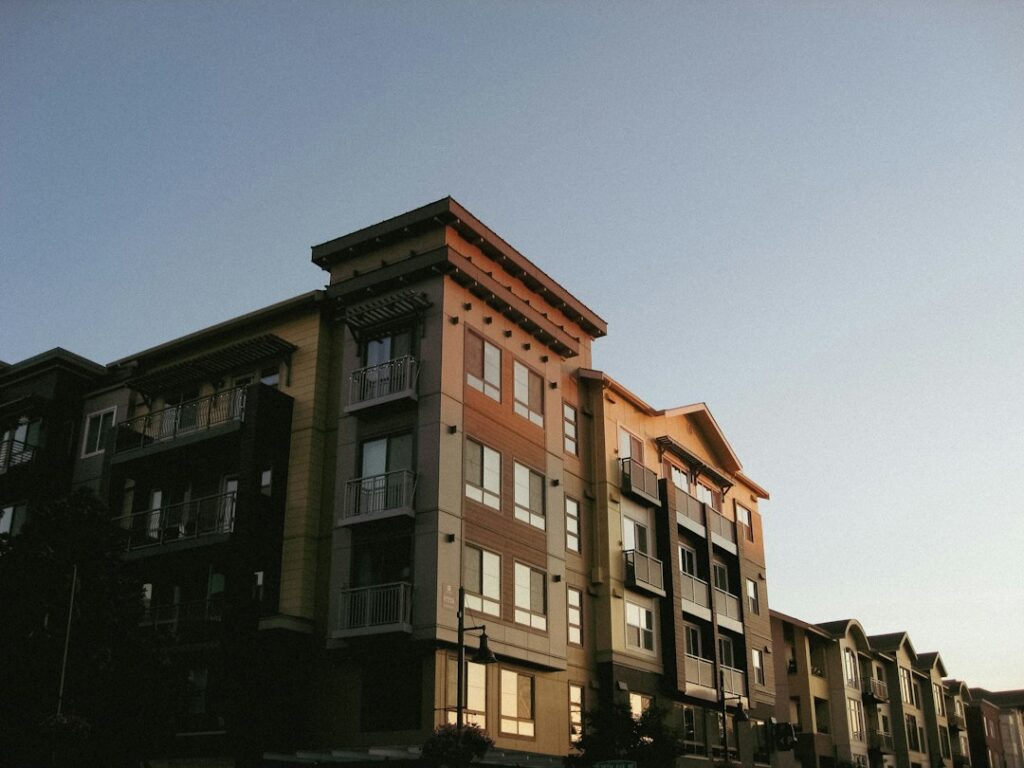
The most visible new apartment project is The Yellowstone, a six-story, 104-unit building in Casper’s Old Yellowstone District developed by Brick & Bond and Stencil Group on a former RV dealership lot. Announced in May 2024, it opened to renters on January 15, 2026, and local reporting said around half of the units were already spoken for at opening.
The building sits in a district the city has been working to revitalize since 2002. By the developer’s account, a master plan was drafted by 2007, and David Street Station became the district’s focal point. The developer describes the project as “104 high-end units,” which makes it a test of demand for upper-tier rentals in a market where apartments averaged $1,063 a month in the 2026 state survey.
Workforce and affordable housing
Two smaller efforts target the other end of the market. On October 20, 2026, Casper City Council agreed to apply for a $15,845,349 Building Resilient Communities grant from the Wyoming Business Council to pay for water, sewer and streets serving a 20-acre infill site near Wyoming Boulevard and Poplar Street, where Harmony Hills Development plans more than 158 housing units. In August 2026, the Wyoming Housing Network announced Goodwill Landing, a project whose first phase will create 24 permanent affordable rental homes in west Casper, funded with a $1 million grant from Wells Fargo.
Neither project changes the market overnight, but together with The Yellowstone they show new rental supply arriving at both the top and the bottom of the price range.
What this means for Casper apartment owners
For owners of existing buildings, the data suggests a market with steady but slow-growing demand and limited, targeted new supply. A few practical points follow:
- Mid-market apartments built in earlier decades compete mainly with each other and with single-family rentals, which averaged about $371 a month more than apartments in the 2026 WCDA survey.
- High-end new units downtown mark a new top of the local market, which can help well-maintained older buildings that offer good value below that level.
- Employer hiring, especially in healthcare, education and new manufacturing in Evansville, is the most important source of new renter households to watch, since population growth alone is close to zero.
- Unemployment near 3% supports steady collections, but a downturn in energy prices would still ripple through service and trade jobs.
Turnover is also where operating costs and demand meet. With units in the 2023 survey leasing in an average of 16 days, a well-run building in Casper can expect short vacancy periods between tenants, which makes make-ready speed and pricing discipline more important than heavy concessions.
Owners also need to handle turnover carefully under Wyoming’s security deposit rule. Under W.S. 1-21-1208, the landlord must return the deposit balance with an itemized list of deductions within 30 days after the tenancy ends or 15 days after receiving the renter’s new address, whichever is later, with an extra 30 days allowed when there is damage to the unit.
For investors studying the market from a distance, these demand drivers matter more than any single rent statistic. Our guide to how passive multifamily investing works explains how operators weigh local employment and supply when evaluating a building.
Watching the next round of data
Several updates will sharpen the picture over the next year: the 2027 WCDA vacancy survey, BLS revisions to the 2026 employment figures, the outcome of Casper’s grant application for the Wyoming Boulevard site and lease-up results at The Yellowstone. Each will show whether new supply is being absorbed without pushing vacancy much above the 5.3% the 2026 survey recorded. For a statewide perspective, see our Wyoming market overview, and for local pricing context, visit our Casper market page.