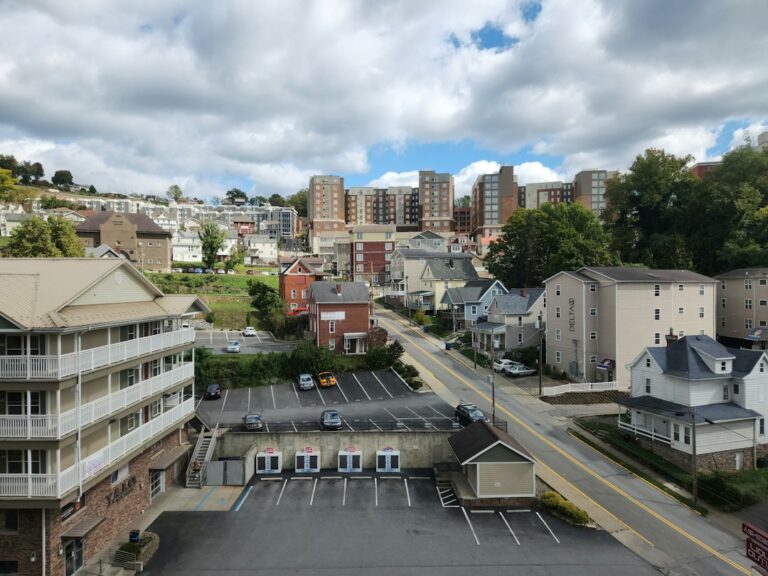
Huntington apartment operating costs are shaped by a long list of local charges that owners in many other states never see: a municipal service fee that pays for fire protection, a per-unit refuse fee for smaller buildings, a 1% city business and occupation tax on rental income, a rental license and inspection program, and Class IV property tax rates that apply to non-owner-occupied property inside the city. On top of those, sewer, water, electric and gas rates all rose in 2025 or 2026.
Huntington is a city of an estimated 44,815 residents as of July 1, 2025, according to Census QuickFacts for Huntington, and it is home to the Cabell County Courthouse and Marshall University. Most of the city lies in Cabell County, with a smaller western portion in Wayne County. The figures below come from the city’s fee schedule and rental program documents, the Huntington Water Quality Board, the West Virginia Public Service Commission, the Cabell County Assessor and HUD, with the year attached because nearly all of them change over time.
The city fees every Huntington rental pays
Huntington funds a large share of its public safety and sanitation budget through user fees rather than property tax alone. For apartment owners, three of them recur every quarter.
The municipal service fee for fire protection
The city’s municipal service fee page describes the fee as paying for fire protection services and maintenance of fire equipment, under Article 773 of the city code. It is $108 a year as a base charge plus $0.0662 per square foot of structure, billed quarterly, with payments due January 31, April 30, July 31 and October 31. The city’s own example, a 2,500-square-foot structure, comes to $273.52 a year.
Applied to apartment buildings, the square-footage component dominates:
- A 6,000-square-foot fourplex: $108 + (6,000 × $0.0662) = about $505 a year.
- A 12,000-square-foot 12-unit building: $108 + (12,000 × $0.0662) = about $902 a year.
- A 30,000-square-foot building: $108 + (30,000 × $0.0662) = about $2,094 a year.
Because the fee is based on building area rather than rent or value, it falls more heavily on older buildings with large common areas, basements and hallways.
Refuse collection and the five-unit line
According to the city’s taxes and fees page, the refuse fee is $20 per month per unit, billed quarterly, with payments due March 15, June 15, September 15 and December 15, under Article 951.
The city’s November 6, 2025 fee schedule states that rental properties of four units or fewer must use city refuse service. The 2025 rental registry packet adds that the city does not collect from multifamily buildings of five or more units, so those owners arrange private hauling. For a fourplex, city refuse costs $960 a year. For larger buildings, the cost depends on a private contract, dumpster size and pickup frequency.
Curbside recycling is voluntary through the city’s contractor, Rumpke. According to the city’s curbside recycling page, it costs $11.61 a month beginning April 1, 2026, plus a one-time $20 charge for a 95-gallon cart, and enrolling earns a $4.50 credit on the quarterly refuse bill.
The city service fee for on-site staff
Huntington also charges a city service fee of $5 per week for each person working inside city limits, under Article 772.04. For an apartment owner with an on-site manager or maintenance technician, that is about $260 a year per employee.
The B&O tax on rental income
Many owners moving into West Virginia are surprised by the municipal business and occupation tax. Huntington’s B&O tax page and its 2025 fee schedule list the classification for rents, royalties, interest and dividends at 1.00% of gross. Returns on rental income from real property may be filed annually for the period ending December 31.
The tax is on gross receipts, not net income, so it behaves like an operating expense rather than an income tax. A worked example:
- A 12-unit building with average rents of $900 a month collects about $129,600 a year in gross rent.
- At 1.00%, the B&O tax is about $1,296 a year, or $108 per unit.
Owners underwriting a purchase should treat this as a fixed percentage of collections and include it in the expense budget alongside insurance and utilities.
Rental licensing and the inspection program
Huntington runs a rental registry and an inspection program that apply to most rental housing in the city.
What registration costs
According to the city’s 2025 rental registry packet:
- The rental registry itself has no fee.
- A Rental General Business License costs $20 and expires on June 30 each year.
- Owners must hold a West Virginia Business Registration Certificate.
- Owners must inform the Cabell or Wayne County Assessor that the property is a rental.
Inspection and re-inspection fees
The same packet lists the fee structure for inspections:
- First inspection: no charge.
- First re-inspection: $50 per unit.
- Second re-inspection: $100 per unit.
- Certificate of Occupancy inspection: $75.
- Violations must generally be corrected within 10 days unless the inspector agrees otherwise.
- The inspection checklist references the 2020 National Electrical Code, the 2018 International Residential Code and the 2018 International Plumbing Code.
The re-inspection fees are where costs can climb. On a 12-unit building where half the units fail a first inspection, a first re-inspection would cost $300, and units that fail again would add $100 each.
How multifamily buildings are inspected
The city’s rental property inspection page explains that the program dates to a 2018 ordinance, Article 1737. One- and two-family units are inspected no more than once in 12 months. Multifamily buildings, defined as more than two units along with dormitories and rooming houses, are inspected by the city’s building, electrical and plumbing inspectors together with the Fire Marshal. Tenants can also request an inspection.
Penalties for non-compliance
Operating unlicensed units or providing false information carries penalties of $200 to $500 per offense and, separately or in addition, $100 per month per unit for each month a unit remains unlicensed. For a 10-unit building left off the registry for six months, the monthly penalty alone could reach $6,000.
Property tax on non-owner-occupied rentals
West Virginia taxes property by class, and rental buildings inside a municipality fall into Class IV. According to the Cabell County Assessor’s FAQ, the 2026 Class IV rate inside Huntington is 3.35040 per $100 of assessed value, double the Class II owner-occupied rate of 1.67520.
A simple illustration: a building with an assessed value of $500,000 would owe about $16,752 a year at the 2026 Class IV rate. The assessed value is set by the county assessor and is not the same as the purchase price, so owners should check the assessor’s record for their parcel rather than applying the rate to a sale price.
Cabell County voters approved a county fire protection levy on May 12, 2026, by 76.8% to 23.2%, raising the Class III and IV rate for that levy from 2.16 cents to 2.80 cents per $100. Huntington’s fire department is among the recipients. The difference is small per building but adds to the cumulative cost of fire protection, which Huntington owners also pay through the municipal service fee.
Utility rates behind Huntington apartment operating costs
Owners who pay common-area utilities or master-metered service have seen several rate actions in 2025 and 2026.
Sewer
Sewer service in Huntington is provided by the Huntington Water Quality Board, the successor to the Sanitary Board. According to the board’s published sewer use ordinance, adopted April 14, 2025, rates rise in phases every January. In the phase effective January 1, 2026, the charge for the first 2,000 gallons is $24.00 per 1,000 gallons, with a minimum monthly bill of $48.00 and usage above 2,000 gallons billed at $12.25 per 1,000 gallons. The minimum bill steps up to $50.40 on January 1, 2027, and continues rising each year through 2030. Each meter is billed separately, a 2% utility excise surcharge applies, and new service requires a $130 deposit.
For apartment owners, the meter configuration matters. A building with one master meter pays one minimum charge and usage charges on the total; a building with individual meters pays a minimum on each. Tenant-paid sewer shifts the cost, but owners still carry vacancy periods.
Water
West Virginia American Water serves Huntington. According to the company’s announcement of the PSC order, the Public Service Commission’s amended order of March 5, 2026 authorized $20.5 million in additional annual revenue, effective March 1, 2026, adding about $6 a month to a residential bill at 3,000 gallons.
Electric and gas
- Appalachian Power: a PSC order dated April 16, 2026 approved a 4% increase in residential and commercial base rates, about $40.1 million in total, effective June 1, 2026. Commercial customers were estimated to see about $11.32 a month, or 2.6%, and the company agreed not to file another base rate case before June 1, 2027.
- Mountaineer Gas: a PSC-approved pipeline replacement settlement took effect January 1, 2026, worth about $5.2 million, or roughly $1.55 a month for an average residential bill, about 1.93%.
For buildings with owner-paid heat or central boilers, the gas increase matters more than the electric change. For buildings with tenant-paid electric and owner-paid common areas, the Appalachian Power increase mostly affects hallway lighting, exterior lighting and laundry rooms.
Insurance, flood protection and fire-loss rules
Insurance is the line item most owners find hardest to benchmark, and there is no official Huntington-specific premium data. A few structural rules, however, affect every policy.
- West Virginia levies a surcharge of 0.55% of taxable premium on every fire and casualty policy under W. Va. Code § 33-3-33, in place since 2005, with proceeds supporting volunteer fire departments.
- Under W. Va. Code § 38-10E-1, municipalities have a lien on fire insurance proceeds of $5,000 or 10% of the proceeds, whichever is greater, to cover removal of fire-damaged structures. Owners should factor that holdback into recovery planning after a loss.
Flood risk is shaped by the city’s floodwall. According to the Huntington Water Quality Board’s description of the system, the floodwall was built between 1939 and 1942 after the 1937 Ohio River flood and includes about 11.4 miles of wall and levee, 17 pump stations and 45 gate openings, operated by the Huntington Stormwater Utility. Whether a specific building needs flood insurance depends on its location on the current FEMA flood map and the lender’s requirements, so owners should check the parcel rather than assume coverage is or is not needed.
Rent levels to set against these costs
Operating costs only make sense relative to income. HUD’s Fair Market Rents for the Huntington-Ashland, WV-KY-OH HUD Metro FMR Area, which includes Cabell and Wayne counties, rose for fiscal 2027, which began October 1, 2026:
- Studio: $858, up from $848 in FY2026.
- One-bedroom: $864, up from $853.
- Two-bedroom: $1,006, up from $973.
- Three-bedroom: $1,287, up from $1,249.
- Four-bedroom: $1,393, down from $1,410.
Those figures, published in HUD’s FY2027 Fair Market Rent schedule, put benchmark rents at roughly $850 to $1,300 for most apartment sizes. Against that income, fixed charges such as the refuse fee at $20 per unit per month and the B&O tax at 1% of rent are a noticeable share of each unit’s budget. Our apartment building value calculator shows how each of these expense lines flows through to value.
A sample budget for a 12-unit building
To see how these charges add up, consider a hypothetical 12-unit, 12,000-square-foot building inside Huntington, with average rents of $900 a month and an assessed value of $500,000. Using only the 2025–2026 figures above, the recurring city and county charges look like this:
- Municipal service fee: about $902 a year.
- B&O tax at 1% of $129,600 in gross rent: about $1,296 a year.
- Rental general business license: $20 a year.
- Class IV property tax at 3.35040 per $100: about $16,752 a year.
Those four items total about $18,970 a year, or roughly $1,581 per unit, which is about $132 per unit per month and about 14.6% of gross potential rent. That figure is before insurance, private trash hauling (required at five or more units), owner-paid utilities, repairs, management and reserves. If the building is on a single master sewer meter, the January 2026 minimum bill alone adds $576 a year before any usage charges.
The exercise shows why property tax dominates the local cost picture: at this assessed value it is close to nine-tenths of the city and county charges. It also shows why the assessed value on the county’s record deserves careful attention, because every $100,000 of assessed value adds about $3,350 a year at the 2026 Class IV rate.
What this means for Huntington apartment owners
When budgeting or underwriting a building in Huntington, the local cost structure suggests a short checklist:
- Add the municipal service fee based on total building square footage, not unit count.
- For buildings of four units or fewer, budget city refuse at $20 per unit per month; for five or more units, price a private hauler.
- Include the 1% B&O tax on gross rents as a fixed expense line.
- Keep the $20 annual rental license current by June 30 and register every unit to avoid $100-per-month-per-unit penalties.
- Budget for re-inspection fees on older buildings, especially those with original electrical and plumbing.
- Use the Class IV rate of 3.35040 per $100 of assessed value, not the Class II rate, when projecting property tax.
- Model sewer increases each January through 2030, and confirm whether the building has one master meter or individual meters.
- Expect utility rate cases to continue; 2026 brought increases from water, electric and gas providers.
Owners thinking about their next move can find local context on our Huntington market page and statewide coverage on the West Virginia markets page. In a city where benchmark rents run from roughly $850 to $1,300, the difference between a well-budgeted building and a surprised owner often comes down to these smaller, recurring local charges.