Lawrence apartment demand comes mostly from three sources: the University of Kansas, which posted its third straight record enrollment in fall 2026; a population in which renters outnumber owners; and a steady, government-anchored job base sitting between Kansas City and Topeka. Together they give Lawrence one of the deepest renter pools of any city its size in Kansas, with demand that follows the academic calendar more closely than the business cycle.
This guide walks through each of those drivers using current figures from the Census Bureau, the university, the City of Lawrence and the Bureau of Labor Statistics, then turns them into practical takeaways for apartment owners and investors watching the market.
A renter-majority city in Douglas County
Lawrence is the county seat of Douglas County and by far its largest city; the county’s other incorporated cities are Baldwin City, Eudora and Lecompton. The Census Bureau’s QuickFacts profile for Lawrence puts the city’s population at 96,367 as of July 1, 2025, up from an April 2020 estimates base of 94,941. That is growth of about 1.5% in a little over five years: modest, but steady, and in line with a college town whose core population renews itself every fall.
The more important number for apartment owners is tenure. According to the same Census profile, the owner-occupied housing rate in Lawrence was 43.6% over the 2020–2024 American Community Survey period. Put the other way, roughly 56% of occupied homes in the city are rented. That is unusual: across the United States, owners are a clear majority, and even in Douglas County as a whole the owner rate is 50.1%. Lawrence itself tips the county toward renting.
The city counted 41,129 households in the 2020–2024 period, with an average of 2.15 people per household. Small households are typical of student and young-professional markets, and they shape what gets rented: studios, one-bedrooms and two-bedroom units shared by roommates make up much of the demand, alongside larger bedroom-count units marketed to student groups.
How Lawrence compares with the rest of the county
The Douglas County QuickFacts profile lists a July 2025 population of 120,920, up about 1.8% since 2020, and 54,513 housing units. With roughly four out of five county residents living in Lawrence, the city is effectively the county’s rental market. The county’s median gross rent of $1,099 is almost identical to the city’s, which tells you that rents in the smaller towns are not meaningfully cheaper once you account for the mix of units.
KU enrollment and Lawrence apartment demand
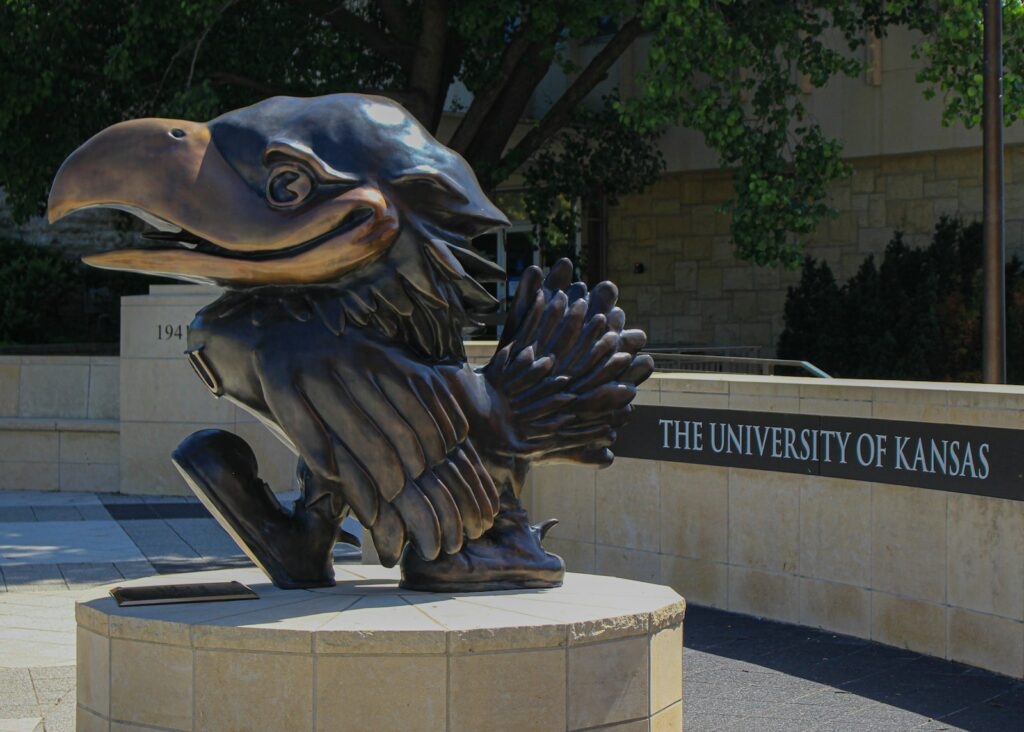
No single factor matters more for Lawrence apartment demand than the University of Kansas. In October 2026 the university reported that total enrollment reached a record 31,464 students, up 295 students, or 0.9%, from the prior year. It was the third consecutive year of record enrollment.
The year before, KU reported total enrollment of 31,169, and a combined Lawrence and Edwards campus headcount of 27,212, which broke a record that had stood since fall 2008. The Edwards campus is in Overland Park, so not every student counted in the total lives in Lawrence, and the total also includes the medical center campuses. Still, the Lawrence campus is where the overwhelming share of undergraduates live, and record headcounts there translate directly into leasing traffic.
Watch the size of each freshman class
One detail in the fall 2026 numbers is worth tracking. The freshman class was 4,834 students, which KU describes as the fourth largest in its history, but it was 4.1% smaller than the 5,040 freshmen who enrolled in fall 2025. Total enrollment can keep rising while an individual class shrinks, because retention and graduate enrollment also feed the headcount.
For apartment owners this matters because of timing. Many first-year students live in university housing, so a smaller freshman class shows up in the off-campus market a year or two later, when that cohort moves out of the residence halls. A large class like fall 2025’s is a tailwind for off-campus leasing in the 2026–27 and 2027–28 lease years; a smaller class is a modest headwind later. Owners whose buildings lean heavily on undergraduates should watch each fall’s release with that lag in mind.
Haskell Indian Nations University
Lawrence is also home to Haskell Indian Nations University, a federally operated university serving students from tribal nations across the country. Its fall 2025 enrollment report lists 899 students, and the school’s summary sheet notes 176 first-time, first-year students representing 148 tribal nations. Haskell’s numbers are small next to KU’s, but they add another layer of student housing need in the south part of the city.
Employers behind year-round renter demand
Students are not the whole story. Lawrence also has a working-age renter base tied to a handful of large employers. The City of Lawrence’s 2023 Popular Annual Financial Report lists the city’s top five employers:
- University of Kansas: 8,845 employees
- LMH Health: 1,945 employees
- Lawrence Public Schools: 1,660 employees
- Berry Global: 1,115 employees
- Hallmark Cards Inc.: 885 employees
The list says a lot about the type of tenant a Lawrence apartment building attracts beyond students. University staff, graduate assistants and postdoctoral researchers; nurses, technicians and support staff at LMH Health; teachers; and production workers at the Berry Global and Hallmark plants all form part of the non-student renter pool. These households tend to sign 12-month leases on regular move-in dates, which helps smooth out the August spike that student-oriented properties see.
What the labor data shows
The BLS economic summary for the Lawrence metro area reported a preliminary unemployment rate of 3.6% for September 2026 and about 55,100 nonfarm jobs. Roughly 15,700 of those jobs, or about 28%, were in government, a category that includes the public university and public schools. That share is high compared with most metro areas, and it cuts both ways: government payrolls tend to be stable through recessions, but they can be sensitive to state budget decisions and university funding.
The commuter link to Kansas City and Topeka
Lawrence sits on the Kansas Turnpike roughly 40 miles west of Kansas City, Missouri, and about 25 miles east of Topeka, the state capital. The city’s economic development materials describe it as about 20 minutes from the western edge of the Kansas City metro and about 45 minutes from Kansas City International Airport.
That location gives Lawrence a second, less obvious source of renters: people who work in Johnson County, Kansas City or Topeka but prefer to live in a university town. The Census profile shows a mean travel time to work of 19.8 minutes for Lawrence residents, which suggests most residents still work locally, but the presence of a commuter group helps explain why demand for apartments with parking and easy highway access holds up outside the campus core.
Lawrence rents, incomes and affordability pressure
The Census profile puts Lawrence’s median gross rent at $1,091 for the 2020–2024 period, up from $1,054 in the 2019–2023 release. Because these are five-year averages, they lag current asking rents and smooth over the year-to-year swings, but the direction is clear. Gross rent includes utilities paid by the tenant, so it is a reasonable proxy for the total housing cost a renter household faces.
Incomes are the other side of the equation. Median household income in Lawrence was $65,009 in 2024 dollars, and the poverty rate shown in QuickFacts is 17.4%. Student households pull both numbers in an unflattering direction, since many full-time students report little income and rely on family support or loans, but the affordability squeeze is real for working households too.
The city’s own affordable housing program page says almost half of all renters in Lawrence, 49%, and 16% of homeowners are “housing insecure,” the city’s term for households paying more than they can comfortably afford. Local reporting in early 2026 cited the same figures as the city sought public feedback on housing.
For owners, that combination of rising rents and stretched renters has two practical implications. First, there is a ceiling on how fast rents can rise for older, workforce-oriented units before turnover and collections suffer. Second, public attention to affordability means owners should expect continued policy activity at City Hall, from incentive programs for affordable units to stricter enforcement of housing standards.
Turnover, mobility and leasing seasons
College towns have high resident turnover, and Lawrence is no exception. The Census profile shows that 72.4% of residents lived in the same house one year earlier, meaning more than a quarter had moved in the previous year. Census Reporter’s summary of the 2024 one-year survey shows 24.3% of residents had moved since the previous year.
High mobility affects an apartment building’s economics in several ways:
- Turn costs are a regular budget item. Painting, cleaning, carpet or flooring replacement and minor repairs happen on a larger share of units each year than in a stable workforce market.
- Leasing is seasonal. Student-oriented buildings often pre-lease months ahead of an August move-in, and units that miss that window can sit empty until the next cycle.
- Lease terms vary. Some owners use academic-year or 11.5-month leases to line up with the semester calendar and leave time for turns between tenants.
- Marketing never really stops. With a large share of residents moving each year, online listings, tours and application processing are year-round work.
Rental licensing as part of the operating picture
Lawrence regulates rental housing directly. When the city expanded its program in the mid-2010s, its rental licensing program brochure explained that all rental dwelling units in the city would be required to be licensed, and that inspectors would choose a sample of 10% of units to inspect. The city’s housing pages still link to rental licensing and license renewal. Fees and procedures can change, so anyone acquiring or managing a building should confirm current requirements with the Planning and Development Services department rather than relying on older documents.
What this means for Lawrence apartment owners
Putting the numbers together, Lawrence apartment demand looks durable but specific. The renter majority, record university enrollment and a stable public-sector employment base support occupancy. At the same time, the market’s character, high turnover, seasonal leasing and an affordability ceiling, shapes how a building should be run and how its income should be read.
A few practical points for owners and investors:
- Know your tenant mix. A building that is 80% students behaves differently from one leased mainly to hospital staff and school employees. Rent rolls, lease start dates and renewal rates tell you which one you own.
- Read enrollment releases with a lag. Freshman class size affects off-campus demand a year or two later, while total enrollment and graduate headcounts affect it immediately.
- Budget realistically for turnover. With more than a quarter of residents moving each year, turn costs and a few weeks of downtime per unit belong in the expense line, not in a contingency.
- Underwrite on trailing numbers. Five-year Census rent figures lag the market. Actual collected rents over the last twelve months are a better guide to what a building earns.
- Keep licensing current. A lapsed rental license or a failed inspection is an avoidable problem, and buyers will ask about both during due diligence.
If you want to see how occupancy, rent levels and turnover costs flow through to a building’s income, our net operating income calculator lets you plug in your own Lawrence numbers and test different vacancy and expense assumptions.
Where to go next
Lawrence is one of several Kansas college and capital-city markets with distinctive renter profiles. For a broader look at the state, including other cities we follow, see our Kansas market overview. If you own a building in town and are weighing your options, our page on selling an apartment building in Lawrence explains how we evaluate properties here, including student-oriented buildings and older walk-ups near campus.
The figures in this guide will change: KU publishes enrollment every fall, the Census Bureau updates its estimates every year, and BLS releases labor data monthly. Checking those sources each year is the simplest way to keep a clear picture of what is driving demand for apartments in Lawrence.