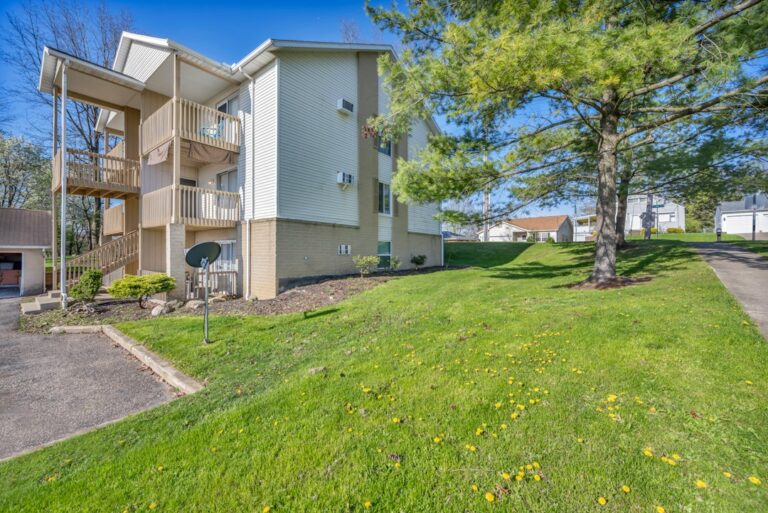
Frankfort apartment property taxes are set in two steps: the Franklin County Property Valuation Administrator assesses each building at fair cash value as of January 1, and then the state, the county, the city, the local school district and several special districts each apply their own rate per $100 of that value. For an apartment building inside city limits, the school district levy is usually the largest piece of the bill, and the assessment itself is usually built on the property’s income.
This guide explains how the assessment works, how and when owners can appeal, what the most recent published rates are, how bills are collected, and which other taxes on rental property owners in Frankfort tend to surprise people.
Kentucky’s fair cash value standard
The starting point is the state constitution. Section 172 of the Kentucky Constitution says that all property not exempted “shall be assessed for taxation at its fair cash value.” In practice that means the price a willing buyer would pay a willing seller, not a fraction of market value as in some states. There is no separate, lower assessment ratio for apartment buildings and no homestead-style protection for rental property.
Frankfort is the state capital and the seat of Franklin County. The city had 28,602 residents in the 2020 Census, and state government is the dominant employer: an analysis of federal employment data by the Kentucky Association of Counties found that state government accounted for 29.3% of Franklin County’s employment in 2023. A large, stable public payroll supports rental demand, while the property tax system that apartment owners deal with is the same one used across all 120 Kentucky counties.
How the Franklin County PVA values apartment buildings
In Kentucky, all real property is assessed by a locally elected official called the property valuation administrator, or PVA. According to the Kentucky Department of Revenue’s explanation of the assessment process for real property, all real property is subject to being revalued every year, and every parcel must be physically inspected by the PVA office at least once every four years.
The same page says commercial properties that generate income are usually valued using the income approach. Apartment buildings fall squarely in that category. Under the income approach, the assessor estimates the property’s potential rent, subtracts vacancy and operating expenses to reach net operating income, and then divides that income by a capitalization rate drawn from the market. The PVA may also look at comparable sales and replacement cost, but for a stabilized building with a rent roll the income approach usually carries the most weight.
Why the income approach matters to owners
Because value is income divided by a cap rate, small differences in assumptions can move an assessment a long way. An assessor who uses market rent rather than actual collected rent, ignores a building’s real vacancy, or applies a lower cap rate than recent sales support can arrive at a value well above what the property would sell for. The reverse can also happen, which is one reason a purchase price is often followed by a reassessment the next January.
Owners who keep clean, current operating statements are in a much better position to discuss value with the PVA. Trailing twelve-month income and expenses, a current rent roll and documentation of any major capital needs are the evidence that carries weight under an income-based valuation.
The annual calendar: assessment date to inspection period
The Department of Revenue’s property tax calendar lays out the statewide schedule:
- January 1: the assessment date for both real and personal property. Value and ownership are fixed as of that day.
- January 1 through March 1: the listing period for real property.
- May: the tax roll opens for public inspection for 13 days beginning on the first Monday in May, ending on the third Monday.
- 25 to 35 days after inspection closes: the county’s local board of assessment appeals convenes.
Counties can operate on adjusted dates in some years, and Franklin County’s PVA website has in the past announced a different inspection window. Because the appeal deadline is tied to the end of the inspection period, owners should confirm the current year’s dates directly with the Franklin County PVA office rather than assuming the statewide default.
Appealing a Frankfort assessment
Kentucky’s appeal process is sequential, and each step has to be completed before the next. Under KRS 133.120, as amended effective July 15, 2026:
- Conference with the PVA. A taxpayer who disagrees with an assessment must first request a conference with the property valuation administrator. Many disputes over income-producing property are resolved at this stage when the owner brings actual operating numbers.
- Local board of assessment appeals. If the conference doesn’t resolve it, the owner may appeal to the county board. The appeal must be filed no later than one workday after the inspection period ends, and it must state the taxpayer’s opinion of the property’s fair cash value. The board fixes the assessment at fair cash value, and an appeal is denied if the taxpayer fails to provide reasonable information about the property’s value.
- Kentucky Board of Tax Appeals. A decision of the local board can be appealed to the Board of Tax Appeals. Owners cannot skip the county board and go straight to the state level. The Claims Commission’s tax appeal instructions give a 30-day window from the issuance of the county board’s notice, require a separate petition for each parcel, and say that an owner that is an LLC or corporation must be represented by an attorney.
The attorney requirement is worth noting for apartment owners in particular, because most buildings are held in an LLC. An individual can represent themselves at the PVA conference and the local board, but an entity-owned building heading to the state level needs counsel. A 2026 bill that would have replaced the Board of Tax Appeals with a new tax tribunal did not pass, so the existing structure remains in place.
Frankfort tax rates for 2025 and 2026
Once value is set, each taxing district applies its own rate, expressed in cents per $100 of assessed value. These are the most recent figures we could confirm from official notices, ordinances and local reporting:
- State of Kentucky: 10.6 cents per $100 for 2025, down from 10.9 cents in 2024, according to the Department of Revenue’s 2025 rate announcement. The state rate is recalculated every year.
- Franklin County Fiscal Court: 18.3 cents for 2025. For 2026, the county’s published notice listed a compensating rate of 17.30 cents and a proposed rate of 17.9 cents.
- City of Frankfort: 19.5 cents for 2025 and 18.8 cents for 2026 under the city’s 2026 rate ordinance, applied to real and personal property.
- Franklin County Schools: a general fund levy of 72.1 cents on real property, approved August 24, 2026, down from 74.2 cents the prior year.
- Frankfort Independent Schools: 105.2 cents for the 2026–27 fiscal year, as reported by the State Journal, up from 102.9 cents the year before.
Bills also include special district levies, such as library, health department and extension district rates, that are not listed above. Which school district’s rate applies depends on where the parcel sits, so the reliable way to see the full stack for a specific building is to read its actual tax bill.
A worked example using 2025 rates
To see how the pieces add up, take a hypothetical apartment building inside city limits and in the Frankfort Independent district, assessed at $2,000,000. Using the 2025 rates above, the state (10.6), county (18.3), city (19.5) and school (102.9) levies total 151.3 cents per $100. That works out to about $30,260 before any special district levies. In the Franklin County Schools district, the same assessment with the 74.2-cent school rate and without the city levy would come to 103.1 cents, or about $20,620, again before special districts.
The example shows why location within the county matters so much: the school levy alone can swing the bill by thousands of dollars on the same value. It also shows why a modest change in assessed value has a real cash effect. At roughly 1.5%, every $100,000 of assessed value adds about $1,500 a year.
How HB 44 limits rate increases
Kentucky rates tend to drift down when assessments rise because of a 1979 law known as House Bill 44. Each year taxing districts calculate a “compensating rate,” the rate that would produce about the same real property revenue as the prior year from existing property. HB 44 lets a district levy a rate that produces up to 4% more revenue than the compensating rate would. A rate above that threshold can be put to a recall vote if petitioners gather signatures equal to at least 10% of the votes cast in the last presidential election, under KRS 132.017.
The state rate follows a similar logic. When the Department of Revenue set the 2025 rate at 10.6 cents, it noted that statewide assessments had risen by an estimated 7.54%, and state law limits growth in state real property revenue, so the rate came down. For owners, the practical lesson is that a rate cut does not necessarily mean a lower bill: if your building’s assessment rose faster than the average, you can pay more even as the rate falls.
Paying the bill: Sheriff and city collection schedules
Frankfort property owners can receive two separate bills. The Franklin County Sheriff collects state, county, county school and special district taxes, while the City of Frankfort Finance Office collects taxes for the city itself and for Frankfort Independent Schools.
For the 2025 tax bills, the Sheriff’s office published this schedule after mailing bills by October 29, 2025:
- November 1–30: 2% discount
- December 1–31: face amount
- January: 5% penalty
- February 1 through April 15, 2026: 21% penalty, after which unpaid bills go to the County Clerk and can be sold
The city’s page says its bills are available by November 1 and due December 31, with a 2% discount for payment before November 30 and a 10% penalty plus interest for late payment. On a building with a $30,000 combined bill, the 2% discount is worth several hundred dollars, which is a good reason to put both collection dates on the calendar and to make sure any lender escrow is paying within the discount window.
Other taxes on Frankfort rental property
Tangible personal property in furnished or appliance-equipped units
Kentucky taxes business personal property separately from real estate. The Department of Revenue’s business personal property FAQ states that furniture and appliances used in rental properties are taxable tangible property. Owners report them on Form 62A500 by May 15 each year. Extensions are not allowed, and late listings carry a 10% penalty if filed voluntarily or 20% if the property is discovered and listed involuntarily. Ranges, refrigerators, washers and dryers, and furnishings in common areas or furnished units all belong on the return.
Net profit license fees on rental income
The City of Frankfort charges a net profit license fee equal to the greater of 1.95% of net profit or $60, and its licensing page says owners with rental income above a gross-receipts threshold are presumed to be in the rental business. The threshold figure on the city’s page contains a typographical error, so owners should confirm the exact amount with the city. Returns are due 105 days after the end of the tax year. Franklin County separately levies a 1% net profit license fee, with returns due April 15; owners should ask the county whether and how it applies to rental income and whether any credit runs between the two fees.
Managing Frankfort apartment property taxes: practical steps
Frankfort apartment property taxes reward owners who stay organized. A few habits make a measurable difference:
- Review the assessment every spring. Annual revaluation means a building’s value can change in any year, not just after a sale or inspection.
- Keep income-approach evidence ready. A current rent roll, trailing twelve-month statements and repair estimates are what a PVA or appeal board needs to see.
- Know your inspection window. The appeal deadline falls one workday after it closes.
- Plan for counsel if the owner is an entity. LLC-owned buildings need an attorney at the Board of Tax Appeals.
- Pay in November. Both the Sheriff and the city offer a 2% discount for early payment.
- File the personal property return by May 15. No extensions are available.
Buyers should also expect the purchase price to inform the next January’s assessment, so underwriting on the seller’s current tax bill can overstate net operating income. Our state-by-state guide to rent control and property taxes puts Kentucky’s system in context alongside other states, and our Kentucky market overview covers the other cities we follow. For owners thinking about what comes after the tax bill, our Frankfort market page explains how we look at apartment buildings in the capital city.