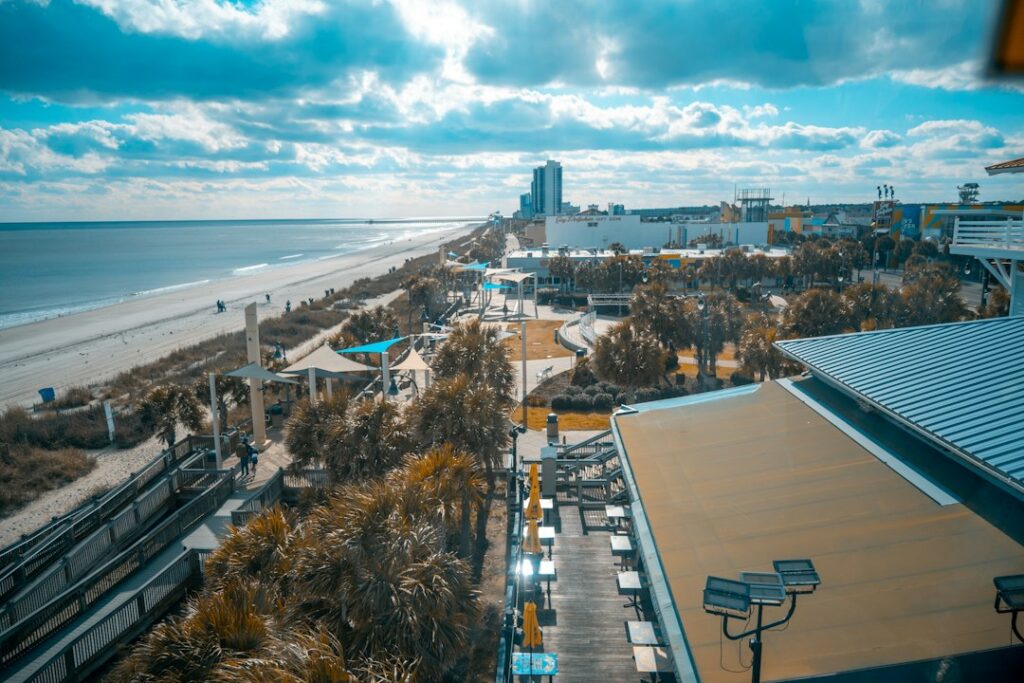
Myrtle Beach apartment operating costs are driven by three things that set the city apart from inland markets: South Carolina taxes rental property at a 6% assessment ratio rather than the 4% used for owner-occupied homes, coastal wind and flood insurance carry hurricane-zone pricing and deductibles, and the city itself bills water, sewer, sanitation and stormwater on a single monthly statement. Add a required business license for every rental property, and an owner’s expense budget in Myrtle Beach looks quite different from one in Columbia or Greenville.
This article breaks those costs down line by line, using state law, Horry County and City of Myrtle Beach records, the state wind pool and FEMA, so owners can see where each number comes from and what moves it.
The setting: a fast-growing coastal city
Myrtle Beach is an incorporated city in Horry County, whose county seat is Conway. Horry County’s FY2026 financial plan describes Myrtle Beach as the county’s most recognizable city and puts the county’s 2024 population at 413,391.
The Census Bureau’s QuickFacts for Myrtle Beach show rapid growth: 35,682 residents in the 2020 Census and an estimated 40,937 on July 1, 2025. For 2020–2024, the owner-occupied housing rate was 60.5%, so roughly four in ten households rent. Median gross rent was $1,261 a month, the median owner-occupied home value was $388,800 and median household income was $60,394.
Those figures frame the expense discussion. A median rent of $1,261 has to cover property tax at a rental assessment ratio, coastal insurance and a full set of city utility charges, so expense control matters as much as rent growth.
Property tax: the 6% ratio and how bills are built
Property tax is usually one of the largest lines on a Myrtle Beach operating statement, so it is worth understanding each step.
Assessment ratios
South Carolina does not tax property on its full market value. Under South Carolina Code section 12-43-220, an owner-occupied legal residence is assessed at 4% of fair market value, while property not otherwise classified, which includes rental housing, is assessed at 6%. The Horry County Assessor notes that property for which no legal residence application is filed is automatically assessed at 6%.
For an apartment building, that 50% higher ratio is the starting point of every tax calculation. A property with a fair market value of $2 million has an assessed value of $120,000 at 6%, compared with $80,000 if it somehow qualified at 4%.
Millage
The assessed value is multiplied by the total millage of every taxing body that covers the parcel: Horry County, the school district, the city and any special districts. Some recent reference points:
- Horry County’s general fund millage for FY2026 remained at 43.9 mills, according to the county’s financial plan.
- The City of Myrtle Beach’s FY2025 budget, approved in May 2024, kept the city’s rate unchanged at 88.9 mills.
- A city incentive ordinance adopted in August 2024 referenced a fixed total millage of no less than 273.2 mills for one project, which gives a sense of the combined rate inside the city once county, school and city levies are added together.
Using a round 270 mills purely as an illustration, the $2 million building above would owe about $32,400 a year ($120,000 × 0.270). The actual combined rate varies by tax district and changes each year, so the parcel’s own tax notice is the only reliable figure.
The homeowner credit apartments do not receive
Myrtle Beach’s Tourism Development Fee funds a property tax credit for owner-occupied homes. In FY2025 that credit was 67.45%. The city’s FY2027 budget announcement reported that the credit for homeowners would fall to 53.4%. Because the credit applies to owner-occupied residences, rental apartments do not share in it, which widens the gap between what a homeowner and an apartment owner pay on a similar value.
Reassessment, the 15% cap and what happens at a sale
South Carolina requires each county to appraise and equalize property once every fifth year under section 12-43-217. Horry County’s previous reassessment took effect in 2019, and its most recent one was implemented for tax year 2024, using a valuation date of December 31, 2023. State law requires a rollback millage after reassessment so that taxing bodies collect about the same revenue overall, though individual bills can still move.
The key protection for existing owners is in section 12-37-3140, which limits increases in fair market value from a countywide reappraisal to 15% over a five-year period. That cap does not apply to additions or improvements in their first taxable year, and it does not apply in the year an assessable transfer of interest, such as a sale, is first taxed.
In practice, this means:
- A long-held apartment building may carry a taxable value well below market, because each reassessment could raise it by no more than 15%.
- When that building sells, the new owner’s value can be reset to market, and the tax bill can jump.
- Buyers and lenders therefore underwrite property tax at the post-sale value, not the seller’s current bill. Sellers who understand this can explain the difference rather than be surprised by it.
Business license fees for rental property
Myrtle Beach requires a business license for rental property, long-term as well as short-term. The city’s business license FAQ states that a license is required for all rental properties, including short-term, long-term, residential and commercial, with short-term defined as less than 90 consecutive days.
Key features of the system:
- The fee is based on the gross receipts of the business, so for an apartment building it scales with rental income.
- New businesses pay based on estimated receipts through May 31.
- Businesses located outside the city pay double the resident rate.
- Renewals are due April 30 each year.
- Late payment carries a penalty of 5% per month, up to 30%.
- Operating without a license is a misdemeanor punishable by a fine of up to $500, up to 30 days in jail, or both.
The city’s FY2027 budget announcement stated that business license fees were not increasing. For budgeting purposes, owners should treat the license as a recurring expense that rises with rent collections.
Utilities: water, sewer, stormwater and power
City-billed services
The city’s utility billing office sends a single monthly bill covering water, sewer, sanitation and stormwater. Sanitation and stormwater are fixed fees, and every water and sewer account pays a base charge in addition to usage. For apartment owners who pay common-area or master-metered utilities, those base charges add up across meters.
Recent changes illustrate the pressures:
- In August 2022, water rates rose 4% and sewer rates 5%, mainly because of higher wholesale costs from the Grand Strand Water and Sewer Authority, and stormwater fees rose $1.67 per month per equivalent residential unit.
- The FY2025 budget raised solid waste fees by $1.01 per month and water and sewer by $5.44 per month for a typical account.
- The FY2027 budget included solid waste and water and sewer adjustments that the city said would total under $7 a month for a typical household.
Because the 2022 increase was driven mainly by wholesale costs from the regional authority, owners should watch that authority’s rates as well as the city’s.
Electricity
Santee Cooper, the state-owned utility, provides retail electric service in Myrtle Beach. Santee Cooper’s rate-study documents state that it directly serves more than 219,000 retail customers in Berkeley, Georgetown and Horry counties, and its Horry-Georgetown Division serves retail customers in Conway, Myrtle Beach and North Myrtle Beach. Owners who pay for common-area lighting, pools, laundry rooms or vacant-unit service should follow Santee Cooper’s rate cases, since they set the cost of every owner-paid kilowatt-hour.
Insurance: wind pool, deductibles and flood
Insurance is where Myrtle Beach most clearly differs from inland South Carolina.
The wind pool
Many coastal owners obtain windstorm and hail coverage from the South Carolina Wind and Hail Underwriting Association when the private market will not write it. According to the association’s coverage questions and answers, its territory in Horry County is divided into two zones. Zone 1 runs east of the Intracoastal Waterway and, farther south, east of US 17 or Bypass 17, which takes in Myrtle Beach’s oceanfront areas. Zone 2 is an inland band bounded roughly by SC 57, SC 9, SC 31, US 501 and Claypond Road.
Terms that matter for apartment owners:
- Maximum limits are $1.3 million for dwellings and condominium units and $2.5 million for commercial risks.
- Standard deductibles are 3% in Zone 1 and 2% in Zone 2, calculated on the insured value, not a flat dollar amount.
- New policies have a 15-day waiting period, so coverage cannot be bought as a storm approaches.
- The association raised dwelling base rates by 8.0% for new and rewritten business effective February 1, 2026, following a previous increase in June 2024.
A 3% deductible on a building insured for $2 million is $60,000 before coverage begins. Owners should treat that figure as a real exposure and keep reserves sized to it.
Flood insurance and the CRS discount
Flood coverage is separate from wind coverage. FEMA lists Myrtle Beach as a Class 5 community in the National Flood Insurance Program’s Community Rating System. Under FEMA’s CRS schedule, Class 5 earns a 25% premium discount for policies inside the Special Flood Hazard Area and 10% outside it. The city has reported that the rating saved about 10,082 policyholders a combined $788,211, an average of about $92 each.
State mitigation incentives
South Carolina’s Omnibus Coastal Property Insurance Reform Act of 2007 created catastrophe savings accounts, income tax credits for retrofits and mandatory insurer discounts for mitigation features. Several of the tax benefits are tied to an owner’s own residence, so investors should confirm which apply to a rental property. The required insurer discounts for qualifying mitigation features are generally the more relevant lever for an apartment building.
Zoning rules that affect how units can be rented
Operating costs also depend on how a building is allowed to be used. The city has drawn a sharp line between short-term and long-term rentals. According to a city announcement, residential “R” zones do not allow short-term rentals except in the RMV, or Residential Multifamily Visitor, district, and fewer than 30 homes are grandfathered elsewhere.
In early 2025 the city went further. As reported by trade and local news outlets, City Council approved an ordinance that bars converting hotels and buildings of more than two units that were built or used for stays of under 90 days into long-term rentals within an overlay covering 114 blocks between Kings Highway and the ocean. The rule followed a 270-day moratorium that began in April 2024, and landlords who already held a long-term rental license were exempt as long as they kept it.
For owners, the practical effect is that a building’s licensed use is part of its value. A property operating legally as long-term housing in the overlay should keep its license current every April, because the license itself preserves that use.
Storm history behind the premiums
Insurers price Myrtle Beach on its storm history. According to the National Hurricane Center’s report on Hurricane Ian, the storm made its final landfall near Georgetown on September 30, 2022, with 70-knot winds, and the Springmaid Pier gauge just south of Myrtle Beach recorded water 5.17 feet above mean higher high water. Four years earlier, Hurricane Florence brought 23.63 inches of rain to a gauge near Loris in Horry County, the highest tropical cyclone rainfall total on record in South Carolina according to the state climatology office, and river gauges along the Waccamaw exceeded previous record crests by three feet or more.
Those two storms illustrate the two separate risks an owner must price: surge and wind near the beach, and river flooding farther inland.
Myrtle Beach apartment operating costs: what they mean for owners
Putting the pieces together, a Myrtle Beach apartment budget has a few distinctive features:
- Property tax at 6%, reset at sale. Long-held buildings may have below-market taxable values; a sale can reset them. Underwrite the post-sale figure.
- Percentage deductibles. Wind deductibles of 2% to 3% of insured value can be far larger than a flat-dollar deductible.
- Location within the city matters. Whether a building sits in wind pool Zone 1 or Zone 2, and inside or outside the Special Flood Hazard Area, can change insurance cost substantially.
- License fees scale with income. The gross-receipts license grows as rents grow and should be budgeted as a percentage of collections.
- Utility base charges add up. Buildings with many meters pay many base charges, which favors efficient metering arrangements.
Before relying on a building’s expense history, it helps to confirm a few Myrtle Beach-specific facts:
- When the property last changed hands, since that determines whether its taxable value has already been reset to market.
- Which wind pool zone it sits in and whether it is inside the Special Flood Hazard Area.
- Whether the business license is current and what gross receipts were reported.
- How many water and electric meters the owner pays for, and which services tenants pay directly.
Small changes in any of these lines move net operating income directly. Running a building’s actual figures through an NOI calculator shows how a higher insurance premium or a post-sale tax reset changes the bottom line.
Comparing Myrtle Beach with the rest of the state
For owners looking at the Grand Strand alongside other South Carolina cities, the South Carolina market overview covers the state’s other markets, where the 6% ratio applies but coastal insurance costs usually do not. Owners weighing their options for a specific building, including selling an apartment building in Myrtle Beach, will find that a clean record of insurance declarations, wind and flood zone designations, utility bills and the current tax notice answers most of the expense questions a buyer will raise.
Myrtle Beach rewards owners who understand its cost structure. The tax rules are fixed by state law, the utility and license charges are published by the city, and the insurance terms are set by the wind pool and FEMA. Owners who track each of them closely can budget with far fewer surprises than the city’s coastal reputation might suggest.