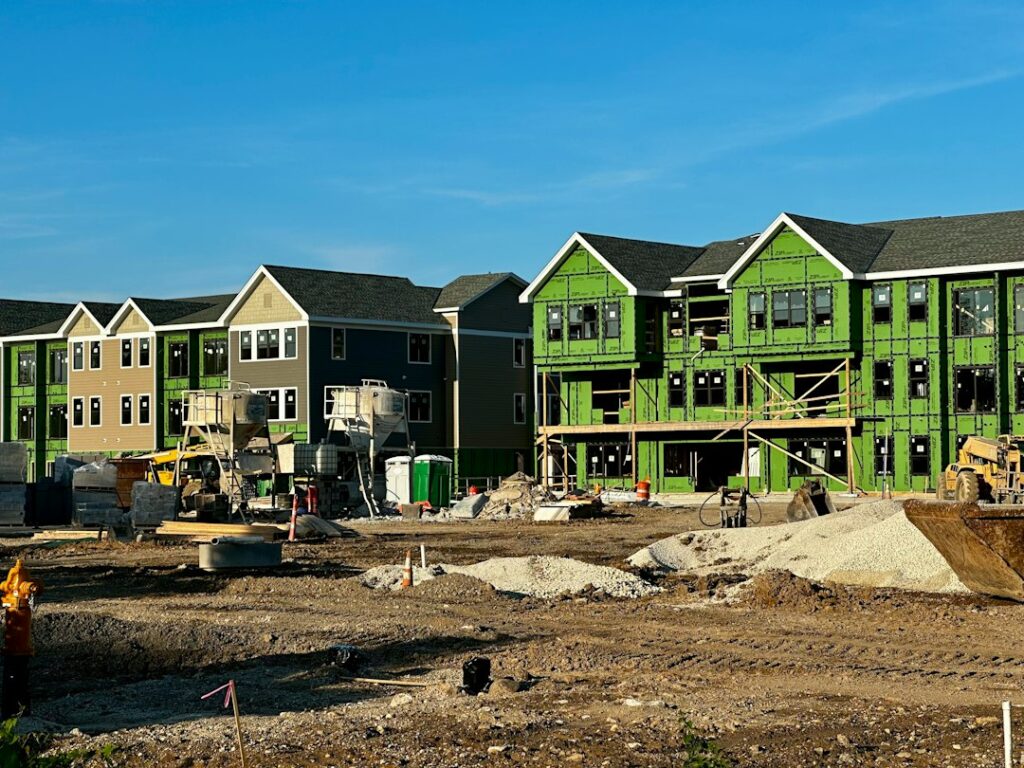
Frederick apartment development is being shaped by three forces at once: a city whose population grew nearly 20% in the last census decade, a planning framework that is steadily opening more land to mixed-use and multifamily housing, and county fees and school-capacity rules that make every new unit expensive to deliver. The result is a pipeline of several large projects rather than a flood of new supply, set against a county housing study that calls for more than 31,000 new homes by 2035.
This article walks through the plans, zoning changes, fees and projects behind that pipeline, using City of Frederick, Frederick County and Maryland state sources, and then looks at what it means for owners of the apartment buildings already standing.
Maryland’s fast-growing second city
Frederick is an incorporated city, chartered in 1816, and the seat of Frederick County, governed by a mayor and city council. The Maryland Department of Planning’s municipal population estimates put the city at 89,537 residents on July 1, 2024, second only to Baltimore among Maryland’s incorporated cities and ahead of Gaithersburg and Rockville.
The pace of growth is what sets it apart. The Census counted 65,239 residents in 2010 and 78,171 in 2020, an increase of 19.8% in a decade. Earlier counts show the longer arc: 40,186 in 1990 and 52,767 in 2000. Housing kept up only partly, rising from 27,559 units in 2010 to 31,802 in 2020, according to the state’s Census comparison for the city. That is a housing gain of about 15.4% against a population gain of 19.8%, so the city added people faster than homes over the decade.
Renters have become a larger share of that growth. In the 2020 Census, 13,724 of 29,945 occupied units were rented, or about 45.8%, up from about 42.4% in 2010. The Census Bureau’s QuickFacts profile for Frederick puts median gross rent at $1,688 and median household income at $95,150 for the 2019 to 2023 survey period. Those figures describe a market where renters have comparatively high incomes and where new apartments compete on quality, location and commute access.
The 2020 Comprehensive Plan sets the rules
The city’s main land-use document is the 2020 Comprehensive Plan, adopted on April 15, 2021 and effective October 1, 2021. It contains 548 goals and policy recommendations, and the city published its first monitoring report on the plan’s progress in January 2026.
The plan’s introduction lays out the growth assumptions that sit behind every rezoning and site plan. It cites a Council of Governments projection of 93,100 residents by 2045, and notes that the city’s housing stock grew about 1.5% a year between 2010 and 2019, from 27,639 to 31,228 units. In other words, the plan expects the city to keep adding thousands of residents, and much of the debate since adoption has been about where and in what form the housing for them will be built.
For apartment owners, the comprehensive plan matters because it is the basis for small area plans and zoning text amendments. Changes that allow more housing on commercial corridors, or more units on a site, start as policy language in this document.
Golden Mile: the first small area plan under the new framework
The Golden Mile, a two-mile commercial corridor along U.S. Route 40 anchored by major retailers, is where the next round of change is most likely. The city adopted its original Golden Mile Small Area Plan on January 17, 2013, to encourage redevelopment of the Route 40 corridor through incentives, public and private investment and legislative policy. The city credits that plan with guiding investment on the corridor, including a tax credit program that has encouraged building rehabilitations. On August 4, 2026, the city launched an update branded FOCUS Frederick, the first small area plan prepared under the 2020 Comprehensive Plan.
The city describes the corridor as serving more than 10,000 households in 17 neighborhoods. The update takes what the city calls a holistic approach, covering commerce, residential vitality, transportation, safety and environmental sustainability. Steering committee meetings run from November 4, 2026 through April 14, 2027, and the published agenda moves through a clear sequence:
- Context, scope and a strengths-and-weaknesses analysis in November 2026.
- Vision and goals in December 2026.
- Development scenarios and transportation in January 2027.
- Public realm and built environment in February 2027.
- A rough draft in March 2027, a public workshop in early April and a final draft presentation on April 14, 2027.
The development scenarios session is the one apartment owners should watch most closely, since that is where the mix of housing and commercial uses on large corridor sites is likely to be debated. Until the update is adopted, there are no new Golden Mile zoning rules in effect, so any expectation of large-scale residential redevelopment on the corridor should be treated as a possibility rather than a plan.
Owners of older garden apartments near the corridor have reason to follow the process closely. Small area plans typically decide where higher-density mixed-use housing is encouraged, how streets and transit are reconfigured and which sites the city prioritizes. Those decisions can raise land values for some parcels and bring new competition close to existing buildings.
Mixed-use zoning now allows ground-floor apartments
A smaller but concrete change took effect in 2026. An ordinance introduced on August 6, 2026 allows apartments to occupy the first floor of vertical mixed-use buildings in the city’s MU-1 and MU-2 districts, where previously the ground floor was expected to hold commercial space. The rule applies only where the first floor is at least 35,000 square feet. That threshold means the change is aimed at large projects rather than small infill buildings. The Frederick News-Post reported on August 24, 2026 that the city council approved it unanimously.
The practical effect is to make some mixed-use projects easier to finance. Ground-floor retail is often the hardest space to lease in a new building, and letting developers substitute apartments on large floor plates reduces that risk. For owners of existing apartments, it means a few more units may be built in mixed-use districts than would otherwise have been feasible.
Affordable housing rules and new housing types
The city runs a moderately priced dwelling unit program that requires larger residential projects to set aside a share of units for low- and moderate-income households or pay a fee in lieu, and council members have been drafting updates to it in 2026. A Mayor’s Affordable Housing Task Force report released in July 2026, as reported by WYPR, concluded that the fee-in-lieu revenue was not enough to meet need and recommended speeding up permitting through a joint review team.
The city is also looking at smaller formats. In July 2026, the Planning Commission reviewed a proposal for “individual living units,” in which tenants rent a private room and share kitchens and bathrooms, according to WYPR. The proposal has not been adopted. If it is, it would add a lower-cost rental product that competes most directly with older studios and one-bedroom apartments.
Frederick apartment development projects in the pipeline
Several large projects show where new units are coming from:
- Residences at East Church, at 605 E. Church Street, is a 350-unit community of five four-story buildings on 14.81 acres by the Goldstar Group, which secured an $83.7 million construction loan in November 2022 and broke ground the following month. It is the furthest along of the projects listed here and the best local test of how quickly large new communities lease up.
- Galleria at Carroll Creek, on South East Street, is a 210-unit, seven-story building with about 4,000 square feet of non-residential space. The Planning Commission approved its site plan in October 2025.
- At 585 Himes Avenue, next to Prospect Center, Frederick County selected developer Conifer in December 2025 to build about 148 affordable units on county-owned land, financed in part with low-income housing tax credits.
- On the northwest side, the city annexed the Christoff property (54.16 acres, up to 228 units) and the Winpenny property (79 acres, about 316 units) in September 2024, opening the way for 544 more homes. The unit types for those sites were not specified when the annexations were approved.
These projects are spread across the East Street corridor, Carroll Creek and the city’s edges, which means new competition will not land evenly. A garden complex on the Golden Mile faces different pressure from a downtown walk-up near Carroll Creek.
Reading the pipeline
A project’s status matters as much as its size. A site plan approval, like Galleria’s in 2025, means the design has cleared review but the building still needs financing and construction. A developer selection, like the county’s choice at Himes Avenue, comes even earlier. An annexation sets the zoning framework but leaves unit types and timing open. Owners estimating future competition should weight projects that are under construction far more heavily than those still in approval, and should expect several years between an annexation vote and the first move-ins.
Fees and school capacity: the cost of a new unit
Frederick County fees add a significant amount to the cost of every new apartment. Under the county’s FY26 impact fee schedule, effective July 1, 2025, the “other residential” category, which is the closest fit for apartments, is charged $9,110 for schools and $534 for libraries, a total of $9,644 per unit. Single-family detached homes pay $19,408 and townhouses $22,087.
On top of impact fees, the county’s Adequate Public Facilities Ordinance can require school construction fees when schools serving a project lack capacity. For “other residential” units, effective July 1, 2025, those fees are $4,166 at the elementary level, $3,124 at the middle level and $3,890 at the high school level, and they adjust each July 1. If all three levels are over capacity, those fees alone add $11,180 per unit.
Why fees favor existing buildings
Fees of this size do not stop development, but they change its math. A developer building 200 apartments may face several million dollars in county fees before construction starts. Those costs tend to be recovered through higher rents on new units, which widens the rent gap between new construction and older buildings and keeps demand steady for well-run existing properties at lower price points.
State density bonuses near the MARC station
Maryland’s Housing Expansion and Affordability Act of 2024, House Bill 538, took effect on January 1, 2025. According to the state housing department’s summary of HB 538, it grants a 30% density bonus in two situations:
- Projects within three-quarters of a mile of a passenger rail station where at least 15% of the units are affordable.
- Projects controlled by nonprofits where at least 25% of the units are affordable.
The bonuses cannot be combined. A proposed limit on local school-capacity rules was removed before the bill passed, so county school fees still apply to bonus projects.
The bill is relevant in Frederick because the city has a passenger rail station. Frederick station, at 100 S. East Street, opened in 2001 on MARC’s Brunswick Line. Sites within three-quarters of a mile of that station that meet the affordability thresholds may qualify for the bonus, which puts parts of downtown and the East Street corridor in play for denser projects.
The countywide housing gap
The biggest number in Frederick’s housing debate comes from a joint county and city housing study released in February 2026. According to the Maryland Association of Counties’ summary of the study, Frederick County will need 31,853 new housing units by 2035 to meet anticipated demand, which works out to roughly 3,500 a year. The study also found that more than 20,000 households earning $75,000 or less spend more than 30% of their income on housing, close to one in five households in the county.
The study organizes its response around five goals:
- Build more homes to meet current and future demand.
- Expand funding to support affordable housing.
- Preserve and maintain existing affordable housing.
- Update county policies to make it easier to build and keep affordable housing.
- Increase staffing and resources to manage housing programs.
The third goal is worth noting for private owners. Preservation programs often focus on older rental buildings with moderate rents, which can mean new financing tools or partnerships for owners willing to keep units affordable.
The 31,853-unit figure is far larger than the visible apartment pipeline. The projects named above add up to roughly 1,250 units across several years of approvals and construction, well under the 3,500 homes a year the countywide estimate implies, although the county total also includes for-sale homes and projects outside the city.
What new supply means for owners of existing buildings
Taken together, these trends point to a market where new construction is meaningful but constrained:
- New apartments will arrive in clusters along East Street, Carroll Creek and annexed land on the northwest side, so owners near those areas should expect lease-up competition and concessions when large buildings open.
- High county impact and school construction fees push the rents of new units up, keeping a cost gap that benefits older buildings with good management and reasonable rents.
- The Golden Mile update, running into 2027, is the most important zoning process to watch for owners near Route 40, because it may encourage higher-density housing on commercial sites.
- HB 538 density bonuses near the MARC station could make denser affordable or mixed-income projects possible downtown, adding supply at the lower end of the market.
- The county’s estimate of 31,853 homes needed by 2035 suggests that, absent a major change in production, demand for existing rental housing should remain firm.
For owners, the most useful exercise is to compare their own rents and operating costs with what new projects must charge to cover land, construction and fees. Our apartment building value calculator can help translate those numbers into an estimated value. Owners weighing their options can read our Frederick market page, and those comparing cities can review other Maryland apartment markets.