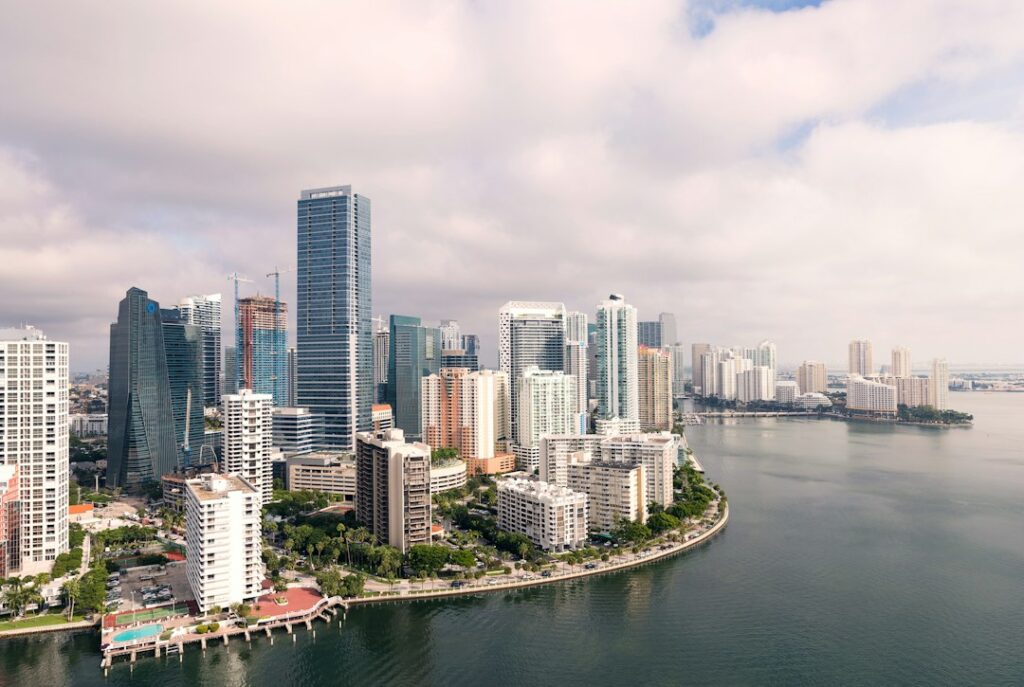
Miami apartment operating costs are driven by a handful of local factors: windstorm and property insurance in the strictest hurricane code zone in Florida, mandatory building recertification once a building turns 30, state security standards that affect liability coverage, and a utility and tax stack that rises each year. For most City of Miami owners, insurance and property taxes are the two largest lines, but recertification and code-driven repairs are the ones most likely to surprise.
This guide walks through each cost category for owners of apartment buildings inside the City of Miami, with current figures from the agencies that set them.
A renter city with old and new stock side by side
Miami is a majority-renter city. The Census Bureau’s QuickFacts profile for the City of Miami estimated 455,924 residents as of July 1, 2023, and its 2019–2023 survey data put the owner-occupancy rate at 30.7%. Roughly seven in ten households rent, and the median gross rent was $1,657 over that period.
That rental base sits in a building stock that spans nearly a century, from small mid-century walk-ups to new high-rises. Operating costs vary widely across that range. An older masonry building may have lower insurance values but heavier recertification and repair needs, while a new tower carries higher insured values but fewer near-term structural bills. The categories below apply to both, in different proportions.
Property insurance after Florida’s reforms
Insurance is the line that has moved most in recent years. Florida lawmakers passed two major packages aimed at the cost of claims:
- SB 2-A, from a December 2022 special session, ended one-way attorney fees in lawsuits over residential and commercial property policies, banned assignment of benefits for residential policies and for commercial policies issued on or after January 1, 2023, and funded a $1 billion state reinsurance program.
- HB 837, signed and effective March 24, 2023, changed rules on attorney fees, bad-faith claims and comparative fault, and shortened the deadline for negligence suits.
State officials say the reforms are working. In a January 13, 2026 release, the Office of Insurance Regulation and the Governor’s office said 17 new insurers had entered Florida since the reforms and that surplus-lines commercial windstorm and hail rates had fallen 47%. Many of the headline rate cuts in that release were for homeowners policies, which are not the coverage apartment owners buy.
Apartment owners who insure through Citizens Property Insurance, the state-backed insurer, should look at the commercial residential lines instead. According to Citizens’ 2026 rate changes, effective for policies on or after July 1, 2026, statewide average rates rose 7.2% for commercial residential multiperil policies and 14.4% for commercial residential wind-only policies, excluding condominium associations. Citizens notes that changes vary by territory, and it did not publish a Miami-Dade-specific figure.
The practical takeaway is that market conditions have improved for some commercial buyers while Citizens’ own commercial residential rates are still rising. Owners renewing in 2026 and 2027 benefit from shopping private and surplus-lines markets alongside Citizens rather than assuming last year’s premium will roll forward.
Building code and hurricane construction rules
Miami-Dade and Broward are the only two counties in the High-Velocity Hurricane Zone of the Florida Building Code, its strictest wind standard. Under the zone’s rules, exterior products such as windows, doors, shutters and roofing generally need a Miami-Dade Notice of Acceptance, a product approval issued by the county.
For an existing building, the zone matters most at replacement time. A roof replacement or window upgrade must use approved products and pass HVHZ inspections, which tends to make those projects more expensive than in most of the state. The upside is that hardened openings and roofs can support a stronger insurance profile, and owners should document every upgrade with permits and product approvals so that underwriters can see it.
Recertification at 30 years
The cost that most often catches Miami owners off guard is building recertification. In the years after the 2021 Champlain Towers South collapse in Surfside, Miami-Dade shortened its recertification cycle from 40 years to 30. Under the county’s building recertification program, buildings now face their first recertification at 30 years and then every 10 years after that. Single-family homes, duplexes and small buildings of 2,000 square feet or less with an occupant load of 10 or fewer are exempt, so nearly every apartment building of five or more units is covered.
Recertification has two parts:
- A structural report prepared by a Florida-registered engineer or architect
- An electrical report, which must include infrared thermography for electrical systems of 400 amps or more
Owners also need certifications for parking-lot lighting and guardrails. Inside city limits, the City of Miami Building Department’s Unsafe Structures Section administers the program, and the city’s recertification page lists a one-time extension fee of $500 when approved. For buildings in the county’s jurisdiction, reports are due within 90 days of notice, the initial review fee is $413.61, the late fee is $465.31, and missed deadlines can lead to a $510 citation and penalties of up to $10,000 per violation, which can become a lien.
The filing fees are the small part. The real budget item is whatever repairs the engineer’s report calls for, from spalling concrete to balcony railings to panel replacements. Owners of buildings approaching the 30-year mark often benefit from commissioning a preliminary condition survey a year or two early, so that repairs can be spread out rather than done under a deadline.
Condo milestone inspections are separate
Florida’s milestone inspection law, enacted in SB 4-D in 2022 and amended by SB 154 in 2023, applies to condominium and cooperative buildings of three or more stories. It is not a requirement for ordinary rental apartment buildings. Owners of rental buildings follow the county and city recertification program described above instead.
Security standards and liability costs
HB 837 also created a new defense for apartment owners in lawsuits over crimes on their property. Under section 768.0706 of the Florida Statutes, owners of multifamily rental property receive a presumption against liability for criminal acts by third parties if they meet a list of security standards:
- Security cameras at entries and exits, with footage kept for at least 30 days
- Parking-lot lighting averaging 1.8 foot-candles from dusk to dawn
- Lighting in common areas
- A one-inch deadbolt on each unit door, plus locks on windows and sliding glass doors
- Locked gates on pool areas
- Peepholes in unit doors that have no window
Owners also need a crime prevention through environmental design assessment that is no more than three years old, and staff security training. The deadlines for both were January 1, 2025, and new employees must be trained within 60 days of hire.
Meeting the standards costs money up front: cameras and storage, lighting upgrades, hardware and a consultant’s assessment. But it can matter for liability insurance and claims exposure, and it ties back to recertification, since the parking-lot lighting certification required at recertification overlaps with the lighting standard.
Water, power and stormwater
Utilities in Miami come from separate providers, each with its own rate path.
Water and sewer
Most City of Miami buildings buy water and sewer service from the Miami-Dade Water and Sewer Department. In its fiscal year 2025-26 budget, the department raised retail water and sewer rates by 3.5% across all tiers. Owners who pay for water in a master-metered building feel that increase directly.
Electricity
Florida Power & Light supplies electricity across the city. On November 20, 2025, the Florida Public Service Commission approved a rate settlement that raises the utility’s base revenue by $945 million starting January 1, 2026, and by another $705 million starting January 1, 2027, according to the utility’s parent company filing. The deal runs through at least 2029. For apartment owners, the effect lands on common-area electricity, including hallway lighting, pumps, elevators and the parking-lot lighting that the security statute requires.
Stormwater
The City of Miami charges a stormwater utility fee of $7.00 per equivalent residential unit per month, and each apartment unit counts as one unit for billing. A 20-unit building therefore pays $140 a month, or $1,680 a year. Ordinance 14432, adopted January 8, 2026, raises the rate by $0.50 a year. The fee is billed on the water and sewer bill, or invoiced directly by the city when a property has no water account.
Flood insurance and the city’s CRS rating
Flood coverage is a separate cost. The City of Miami participates in FEMA’s Community Rating System, which rewards local floodplain management with discounts on National Flood Insurance Program premiums. Since 2022, the city has held a Class 6 rating, which gives NFIP policyholders a 20% discount in Special Flood Hazard Areas and 10% elsewhere, according to the county’s 2024 rating summary. Unincorporated Miami-Dade, by comparison, holds Class 3.
Garbage, licenses and annual permits
Several smaller recurring costs come from city rules:
- Garbage: owners of City of Miami buildings with more than four units must hire a city-approved private hauler rather than use city collection.
- Certificate of Use: the city requires a Certificate of Use for businesses, and its renewal, which also covers the annual Fire Safety Permit, comes due each September 30. The application fee is $50, and a separate Business Tax Receipt is also required. Owners should confirm with the city which of these apply to their building.
- State license: the city notes that multifamily buildings of five or more units also need approval from the Florida Department of Business and Professional Regulation.
Landlord-tenant rules themselves are now set largely at the state level. HB 1417, effective July 1, 2023, preempted local regulation of residential tenancies to the state, which limits how far county or city ordinances can add tenant-related requirements.
Property taxes and assessment caps
Property taxes are usually the largest single expense after insurance. Miami-Dade’s 2025 adopted millage chart shows a total levy of 19.9878 mills for property in the City of Miami, down slightly from 20.0332 in 2024. At that rate, a building with a taxable value of $5 million would owe roughly $99,900 a year before any exemptions.
Florida limits how fast the assessed value of non-homestead property can rise:
- Residential buildings of nine or fewer units are capped at 10% a year under section 193.1554 of the Florida Statutes.
- Buildings of 10 or more units are also capped at 10% a year, under section 193.1555.
- Both caps reset to market value after a sale or a change of ownership or control of more than 50%. Under section 193.1555, an improvement that raises value by 25% or more can also trigger a reset.
The reset is a planning issue for buyers, because a purchase price well above the current assessed value can produce a large jump in the next tax bill.
Newer buildings with income-restricted units may qualify for the Live Local Act exemption created in 2023. It applies to newly built projects with more than 70 qualifying units, giving a 75% exemption for units affordable at 80% to 120% of area median income and a 100% exemption for units at 80% or below, subject to certification and annual application.
Budgeting for Miami apartment operating costs
Put together, these costs suggest a practical approach for Miami owners:
- Track the building’s age against the 30-year recertification date and reserve for repairs well before the notice arrives.
- Shop insurance across Citizens, private and surplus-lines carriers at each renewal, with documentation of roof, window and security upgrades ready.
- Confirm the building meets each item in the section 768.0706 security list and keep the assessment current.
- Model utility increases separately for water and sewer, electricity and the stormwater fee, since each changes on its own schedule.
- Underwrite property taxes at market value if the building may change hands, not at the capped assessed value.
Every one of these lines flows directly into net operating income. Owners can test how changes in insurance, taxes or utilities move the bottom line with our NOI calculator, compare Florida markets on the Florida market page, or read about selling an apartment building in Miami for more on the local market.