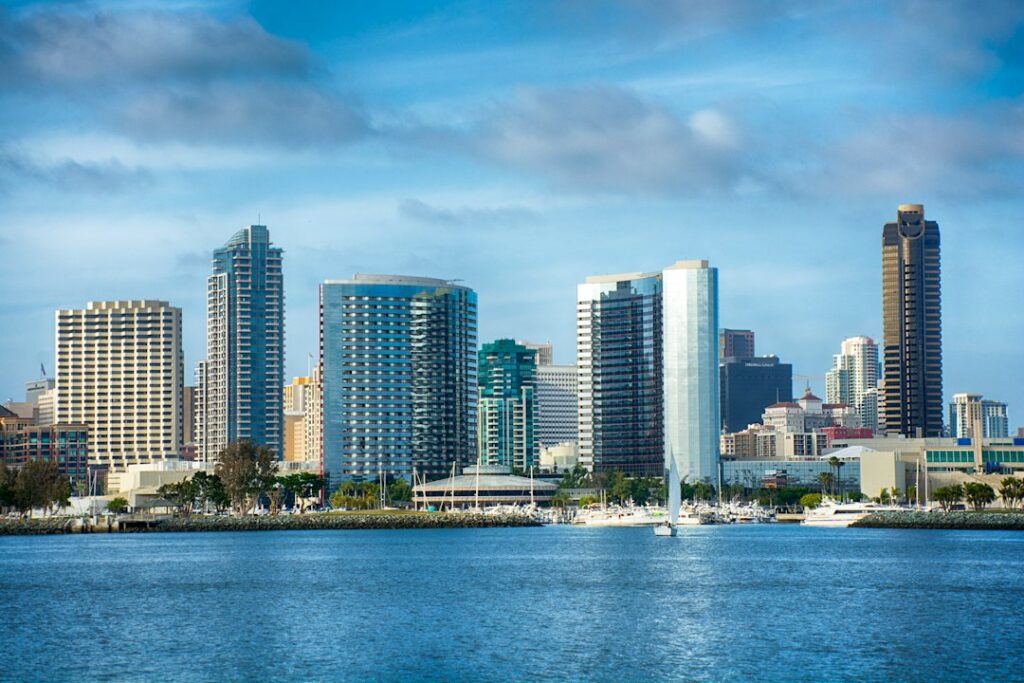
San Diego apartment development is being steered toward transit corridors and a handful of upzoned community plan areas, with the city permitting between roughly 7,600 and 9,700 homes a year from 2023 through 2025, most of them in multifamily buildings. The policy tools behind that shift include the Complete Communities Housing Solutions program, the city’s Housing Action Packages, the bonus ADU program and, since July 2026, state-mandated upzoning near transit under Senate Bill 79.
For owners of existing apartment buildings, those changes affect two things at once: how much new competition arrives in their submarket, and how much their own land could be worth to someone who wants to build more on it. This article covers both.
The target San Diego is building toward
The City of San Diego is an incorporated city in San Diego County. The Census Bureau’s QuickFacts profile for San Diego estimates 1,406,106 residents on July 1, 2025, up from 1,386,932 in the 2020 Census. The owner-occupied housing rate was 47.3% for 2020 to 2024, so a majority of the city’s households rent, and median gross rent was $2,313.
State law requires each region to plan for its share of housing need. According to the city’s Housing Element and annual housing reports page, San Diego’s share of the 2021–2029 Regional Housing Needs Assessment is 108,036 homes. The City Council adopted its Housing Element on June 16, 2020, and the state certified it on September 10, 2021.
The city’s 2025 progress report to the state breaks that target down by income level:
- Very low income: 27,549 homes
- Low income: 17,331 homes
- Moderate income: 19,319 homes
- Above moderate income (market rate): 43,837 homes
That report shows 40,626 units counted toward the target to date, leaving 67,410 remaining. Progress is uneven: market-rate housing had reached 32,833 of its 43,837 target, while very low-income housing stood at 2,920 of 27,549. That imbalance is a big reason the city’s newer programs emphasize affordability requirements in exchange for extra density.
San Diego apartment development by the numbers
Permit activity has risen meaningfully over the past decade. The city’s 2025 Annual Report on Homes, which covers calendar 2024, lists homes permitted each year:
- 2014: 2,408
- 2015: 4,932
- 2016: 7,384
- 2017: 5,014
- 2018: 3,889
- 2019: 5,197
- 2020: 6,482
- 2021: 7,586
- 2022: 5,397
- 2023: 9,693
- 2024: 8,782
The report says the city approved an average of about 9,200 homes a year across 2023 and 2024. Multifamily housing made up 6,166 units, or 70% of homes permitted in 2024, and 85% of all permitted homes were located near transit in the city’s Mobility Zones 1 and 2.
The 2025 progress report to the state adds the most recent year. It shows 7,630 homes permitted in 2025, including 5,094 units in buildings with five or more units, 2,165 accessory dwelling units and 2,050 deed-restricted affordable homes. The affordable homes split into 651 at very low income, 779 at low income and 620 at moderate income. Because the city’s annual report and its state progress reports count some past years differently, the figures above are each quoted from a single source.
Complete Communities: density in exchange for affordability
The single most important local tool for apartment development is Complete Communities Housing Solutions, adopted on November 9, 2020. It offers floor-area-ratio (FAR) based incentives within a half mile of major transit, in return for what the city describes as its strongest affordability requirements for mixed-income projects.
The city’s Complete Communities information bulletin (IB-411) sets out the main rules:
- Eligibility. The site must be in a Sustainable Development Area and zoned to allow at least 20 homes per acre.
- Affordability. Rental projects must deed-restrict at least 40% of the homes allowed before the bonus, typically 15% at very low income, 10% at low income and 15% at moderate income.
- Floor area. There is no FAR maximum downtown, an 8.0 FAR in regional employment areas, 6.5 in Transit Priority Areas within Mobility Zone 3 and 4.0 in Transit Priority Areas within Mobility Zone 4. The Coastal Overlay is limited to a maximum FAR of 2.5, and projects with family-sized units can earn an additional 1.5 FAR.
- Neighborhood transitions. Next to single-family zones, extra height is capped at three stories or 33 feet.
The program has become a significant source of new apartments. The 2025 Annual Report on Homes counted 1,919 homes permitted under Complete Communities in 2024 and noted that 3,372 homes permitted between 2021 and 2024 were concentrated in just eight community plan areas.
Housing Action Packages and parking reform
San Diego has also amended its development code in a series of packages. The city’s Housing Action Package page describes two rounds so far:
- Housing Action Package 1.0 was adopted in February 2022 and took effect on April 10, 2022 outside the Coastal Zone and September 12, 2024 inside it.
- Housing Action Package 2.0 was adopted in December 2023, after the council rejected an earlier version in November. It took effect on March 16, 2024 outside the Coastal Zone and March 11, 2026 inside it.
Package 2.0 matters to apartment owners for several reasons. It implemented state law AB 2097, which removes parking minimums from properties within Transit Priority Areas. It added a 0.5 FAR bonus for homes on underused commercial sites and expanded Complete Communities with a 100% moderate-income option and a family-housing bonus. It also made the city’s dwelling unit protection regulations permanent, which places conditions on projects that would demolish existing homes.
Parking reform predates both packages. On March 4, 2019, the City Council reduced the minimum parking requirement for new multifamily housing in Transit Priority Areas from one space per unit to zero. For infill developers, that change, combined with AB 2097, means a building near transit no longer needs to dedicate expensive land or podium space to parking unless the market demands it.
The city has also sped up review for fully affordable projects. Its Affordable Housing Permit Now program, which began with a 2023 executive order, had permitted 6,746 homes over three years as of April 2026, with an average staff review time of nine days against a 30-day target. Faster approvals for 100% affordable buildings add more income-restricted supply, which competes most directly with older, lower-rent market-rate apartments.
ADUs and the 2025 bonus ADU overhaul
Accessory dwelling units have become a large part of San Diego’s housing output. The 2025 Annual Report on Homes says the city permitted 2,285 ADUs in 2024, the most ever in a single year, and that the bonus ADU program accounted for 653 of them and 892 over 2021 to 2024.
The bonus ADU program allowed some lots to add many more units than state law alone would allow, and its use in single-family neighborhoods drew pushback. On July 22, 2025, the City Council adopted amendments, which took effect on August 22, 2025 outside the Coastal Zone. According to the city’s page on the 2025 ADU code amendments, the changes clarify where the program applies and how many ADU homes are allowed in single-family zones, and they add requirements on evacuation-route access, fire sprinklers and parking, along with penalties and a new Community Enhancement Fee. The city’s proposal called for one parking space per bonus ADU outside Transit Priority Areas and minimum fines of $10,000 per unit per month for violating affordable-rent restrictions.
For apartment owners, the ADU market matters mostly as competition. Small backyard units often rent in the same price range as older one-bedroom apartments, so heavy ADU production in a neighborhood adds supply at the lower end of the market.
SB 79 and state-mandated density near transit
The newest change comes from Sacramento. Senate Bill 79, signed in October 2025, requires cities in large urban transit counties, including San Diego County, to allow housing at higher densities near qualifying transit stops and to approve qualifying projects ministerially. The law’s start date for San Diego is July 1, 2026.
According to a summary by the law firm Buchalter, the law sets tiered standards for qualifying projects:
- Tier 1 stops (heavy rail), within a quarter mile: up to 75 feet, 120 homes per acre and a 3.5 FAR
- Tier 1 stops, a quarter to a half mile: up to 65 feet, 100 homes per acre and a 3.0 FAR
- Tier 2 stops (light rail and frequent bus), within a quarter mile: up to 65 feet, 100 homes per acre and a 3.0 FAR
- Tier 2 stops, a quarter to a half mile: up to 55 feet, 80 homes per acre and a 2.5 FAR
For comparison, Complete Communities already allows higher FARs in parts of the city, so SB 79’s biggest effect may be in places the local program does not reach and in the speed of approval rather than the maximum size of a building.
The city responded with an implementation ordinance. On May 20, 2026, the City Council passed Ordinance O-22099, phasing the implementation of SB 79, with final passage the following day. It delays or exempts certain areas, including low-resource areas, very high fire hazard zones, historic sites and areas at risk from sea-level rise. The ordinance also noted that SANDAG had not yet published its map of qualifying stops, so the exact parcels affected were still being defined.
Community plan updates add capacity in specific neighborhoods
Upzoning has also happened neighborhood by neighborhood through community plan updates. Each adds zoned capacity, not guaranteed construction, but they show where the city expects growth to go:
- Mira Mesa, adopted December 5, 2022, expanded capacity by 24,000 homes.
- University, adopted July 30, 2024, allows up to nearly 29,000 new homes.
- Hillcrest, adopted the same day, allows up to 17,200 additional homes.
- Clairemont, adopted December 16, 2025, adds capacity for 14,000 new homes.
- College Area, adopted the same day, adds capacity for up to 17,750 homes.
Where these plan areas overlap with Transit Priority Areas, the added capacity stacks with Complete Communities incentives and, where it applies, SB 79. In plan areas like these, older garden apartments and small walk-ups can sit on land zoned for far more than they hold.
A hypothetical transit-area site, step by step
To see how these rules interact, consider a hypothetical half-acre lot, about 21,780 square feet, holding a 1960s two-story building with 16 apartments. Assume the lot sits in a Transit Priority Area within Mobility Zone 3 and qualifies as a Sustainable Development Area.
- Under Complete Communities, a 6.5 FAR would allow roughly 141,000 square feet of building. Depending on unit sizes and common areas, that could mean well over 100 apartments instead of 16.
- Affordability would be required. A rental project using the program must deed-restrict at least 40% of the homes allowed under the base zoning, at the very low, low and moderate income mix the bulletin describes.
- Parking would be optional. Because the site is in a Transit Priority Area, the city’s 2019 reform and AB 2097 remove minimum parking requirements.
- Existing tenants would matter. Demolishing 16 occupied units brings in the city’s dwelling unit protection rules and state and local no-fault termination requirements, which add cost and time.
None of this means every such building should be redeveloped. Construction costs, financing, the affordability obligation and the time needed to deliver a vacant site all reduce what a developer can pay. But the example shows why a modest older building near transit can attract interest from buyers who are looking at the land as much as the rent roll.
Rent rules that apply alongside new supply
Development policy does not operate in isolation. Existing apartment buildings in San Diego are subject to state and local tenant rules that new buildings may not be:
- Statewide rent cap. Under AB 1482, annual rent increases on covered housing more than 15 years old are capped at 5% plus the change in the cost of living, with a 10% maximum, according to the California Attorney General’s guide to statewide rent caps.
- Local tenant protections. San Diego’s Tenant Protection Ordinance took effect on June 24, 2023. It applies protections from the first day of a lease and requires relocation assistance for no-fault terminations.
- Costa-Hawkins limits. Under state law, local rent regulation generally cannot apply to buildings with a certificate of occupancy issued after February 1, 1995.
These rules also shape redevelopment. Owners who plan to demolish or substantially remodel occupied buildings face no-fault termination requirements, and the city’s dwelling unit protection rules add further conditions. Separately, SB 9 lot splits cannot be used on housing that a tenant has occupied in the last three years.
What this means for San Diego apartment owners
The development picture creates both pressure and opportunity for owners of existing buildings:
- New supply is concentrated, not uniform. Most new apartments are going up near transit and in a few upzoned plan areas. Buildings in those corridors face more new competition, while buildings in areas with little new zoning see less.
- Land value can exceed building value. An older low-density property on a site eligible for Complete Communities or SB 79 densities may be worth more to a developer than as a stabilized rental, especially where parking is no longer required.
- Affordable obligations come with density. The largest bonuses require deed-restricted units, which affects how much a developer will pay for a site.
- Tenant rules affect timing. Rent caps, relocation obligations and dwelling unit protections all influence how and when an occupied site can be redeveloped.
- ADUs compete at the low end. Heavy ADU production in single-family neighborhoods adds rental supply that overlaps with older studio and one-bedroom units.
Owners exploring a sale should look at their property through both lenses: as an operating building and as a development site. If you are weighing a sale and a reinvestment, our guide to selling an apartment building through a 1031 exchange explains how deferral works. For broader context on the state, see our California multifamily market overview, and for how we evaluate properties locally, visit our San Diego market page.