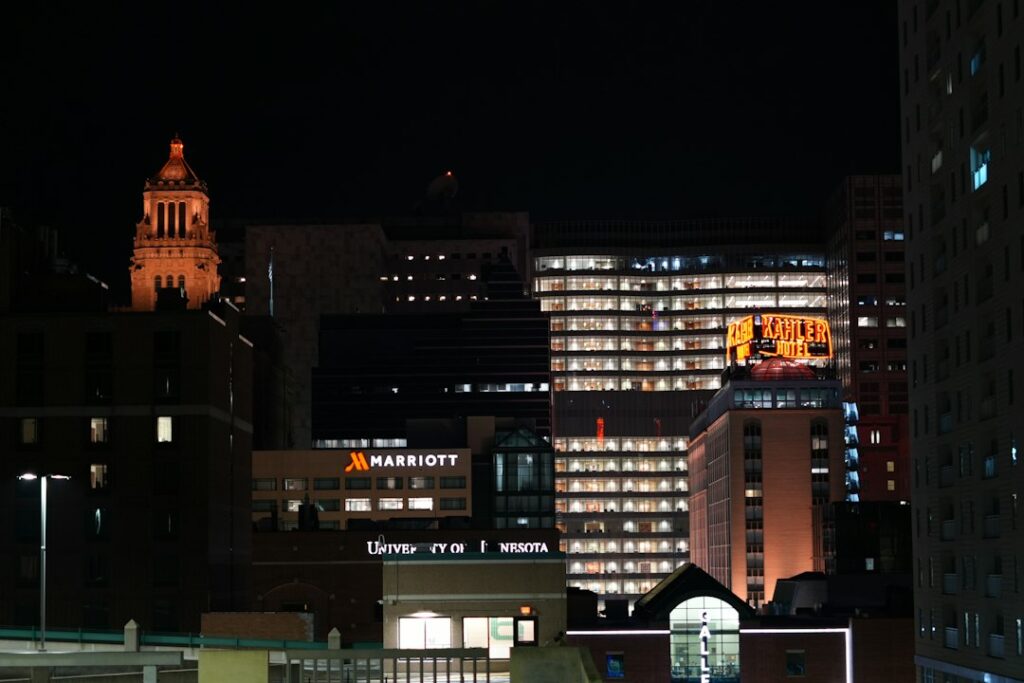
Rochester apartment demand rests on one employer to an unusual degree: Mayo Clinic employs roughly 50,000 people in the area, and its $5 billion downtown expansion, scheduled to finish around 2030, is expected to add thousands more jobs. HUD’s most recent analysis calls the local rental market “balanced,” with apartment vacancy falling to 6.9% at the end of 2025 and steady forecast demand for new units through 2029.
Rochester is the seat of Olmsted County and Minnesota’s third-largest city. It had 121,395 residents in the 2020 Census, and the U.S. Census Bureau QuickFacts estimate for July 1, 2025 is 124,292, a gain of about 2.4%. Unlike many cities its size, Rochester’s renter base is shaped less by a university or a military installation than by a medical campus that draws patients, clinicians, researchers and support staff from around the world. This post looks at who rents in Rochester, what is driving that demand, how much new supply is coming, and what the data suggests for owners of existing buildings.
Who rents in Rochester
The Census Bureau’s American Community Survey for 2020–2024 puts the city’s owner-occupancy rate at 65.1%, which means about 35% of Rochester households rent. The city has 51,131 households averaging 2.34 people each. The 2025 Olmsted County Comprehensive Housing Study, prepared by Maxfield Research for the Coalition for Rochester Area Housing, reaches a similar split of about 64% owners and 36% renters.
The same ACS data shows a median gross rent of $1,399 for 2020–2024. That figure covers all rental housing, including single-family rentals and older units, and tends to lag current asking rents because it reflects leases signed over a five-year window.
Those percentages translate into a sizable renter base. Applying the 35% renter share to 51,131 households suggests roughly 17,900 renter households in the city itself, before counting the surrounding parts of Olmsted and Dodge counties that HUD includes in its metro analysis. That is the pool that new jobs at Mayo and elsewhere add to each year.
The renter pool itself is unusually varied for a city of Rochester’s size. It includes:
- Clinical and research staff at Mayo Clinic, from early-career residents and fellows to long-tenured employees.
- Support workers in food service, environmental services and administration across the medical campus.
- Employees of the area’s other large employers, from the school district to IBM.
- Students at the University of Minnesota Rochester and Rochester Community and Technical College.
- Patients and family members who need furnished or flexible housing during extended treatment.
Mayo Clinic and the employers behind Rochester apartment demand
Rochester’s employment base is dominated by health care. The RAEDI 2025 Community Profile lists Mayo Clinic at 50,385 employees for 2024–25, far ahead of any other employer. HUD’s analysis, which covers a larger four-county area, puts Mayo at about 52,000. Either way, a single institution accounts for a share of local jobs that few American cities can match.
The next-largest employers listed in RAEDI’s profile, with 2024–25 estimates, are:
- Rochester Public Schools: 2,959 employees.
- IBM: 2,791 employees.
- Olmsted Medical Center: 1,432 employees.
- Olmsted County: 1,426 employees.
- City of Rochester: 1,312 employees.
That concentration cuts both ways for apartment owners. Mayo’s long-term investment in Rochester has made demand unusually durable, but it also means the rental market moves with one institution’s hiring, scheduling and building plans more than with the broader regional economy.
Jobs compared with forecast housing need
Putting the employment and housing forecasts next to each other is instructive. HUD expects the expansion to add about 4,000 jobs by early 2029, and it forecasts demand for 1,850 new rental units over roughly the same period. Not every new employee will rent, some will live outside the metro, and some households will include more than one new worker, so the two figures are not meant to match one for one. But the comparison shows why HUD treats Mayo’s hiring as the main engine of rental demand, and why a delay or acceleration in that hiring would show up quickly in local vacancy.
Patients and visitors as a demand layer
Mayo also brings a steady flow of people who are not employees. Destination Medical Center describes Mayo as serving more than 2 million patients and companions a year, and Mayo’s own report on its 2025 performance cites patients from all 50 states and more than 140 countries. Most visitors stay in hotels, but longer treatment stays create demand for furnished apartments and short-term leases near downtown, a niche that some Rochester owners serve directly.
The $5 billion expansion and Destination Medical Center
On November 28, 2023, Mayo Clinic unveiled Mayo Clinic’s $5 billion Bold. Forward. Unbound. in Rochester plan, which includes five new buildings, two of them clinical towers downtown, with construction running about six years starting in 2024. HUD describes the program as roughly 1.8 million square feet of medical space finishing in 2030 and expects it to add about 4,000 jobs by early 2029. Local reporting in 2025 noted that more than 4,000 covered parking spaces are coming online from 2026 as part of the work.
The expansion sits inside a larger public-private framework. The Destination Medical Center initiative is a 20-year economic development program authorized by the Minnesota Legislature in 2013. Its key figures:
- The state committed $585 million over 20 years for public infrastructure.
- The full plan anticipates $5.6 billion of private investment: $3.5 billion from Mayo and $2.1 billion from other private investors.
- The goal is more than 30,000 new jobs.
DMC organizes downtown into six subdistricts: Heart of the City, Discovery Square, St. Marys Place, Downtown Waterfront, Central Station, and UMR/Recreation. For apartment owners, those subdistricts are a useful map of where public investment, new employment space and new residential projects are most likely to cluster.
Construction workers as a near-term renter group
A building program of this size also brings a temporary workforce. Construction crews on multi-year medical projects often rent locally for the duration, adding short- to medium-term demand that fades as the work winds down around 2030. Owners should be careful not to treat that layer as permanent when underwriting long-term occupancy, and buildings that fill a large share of units with project-based renters should plan for the turnover that follows when major phases are completed.
What the rent and vacancy data shows
Two recent studies give a detailed picture, and they measure slightly different things, so it helps to read them side by side.
HUD’s 2026 Rochester housing market analysis, with data as of January 1, 2026, covers the Rochester metropolitan area of Olmsted and Dodge counties, with about 235,200 people and projected growth of about 0.8% a year. It reports:
- Apartment vacancy of 6.9% in the fourth quarter of 2025, down from 8.6% a year earlier.
- An average apartment rent of $1,533, up $29, or 2%, from a year earlier.
- An overall rental market condition HUD classifies as balanced.
The Maxfield Research study, conducted in early 2025 for its own defined market area, found market-rate vacancy of 3.0% in the first quarter of 2025 and an average market-rate rent in Rochester of $1,488 a month, or $1.71 per square foot.
The two vacancy numbers differ because the studies use different methods, geographies and dates, not because one is wrong. HUD’s figure follows apartment properties across the metro at the end of 2025, after a wave of new deliveries; Maxfield’s reflects a survey of market-rate properties in the first quarter of 2025. Read together, they describe a market that absorbed a large amount of new supply and was tightening again by late 2025, with modest rent growth rather than rapid gains.
Three rent figures, three different measures
Owners comparing sources will notice three different rent numbers for Rochester, and each measures something different. The Census Bureau’s $1,399 is a median gross rent, which includes estimated utility costs, covers every kind of rental from single-family houses to older walk-ups, and pools five years of survey responses, so it trails current asking rents. HUD’s $1,533 is an average rent for apartment properties at the end of 2025. Maxfield’s $1,488 is an average for surveyed market-rate properties in early 2025, and it excludes income-restricted units. For underwriting a specific building, the market-rate surveys are the closer comparison, while the Census figure is better at showing what the broad renter population actually pays.
Translating the averages to a single building
Market averages become more useful when applied to one property. At HUD’s average rent of $1,533, a unit generates about $18,400 a year in scheduled rent. HUD’s reported annual increase of $29 a month adds about $348 per unit per year, or roughly $8,350 a year across a 24-unit building. Vacancy matters even more: the difference between 8.6% and 6.9% vacancy on that same 24-unit building is about 0.4 of a unit on average, worth roughly $7,500 a year at the average rent. In a balanced market, small changes in occupancy can move net income as much as a year of rent growth.
How much new supply is coming
Rochester has been building. City permit data reported by RAEDI shows 689 multifamily units permitted in 2024 (a year-to-date figure), up from 549 in 2023. HUD’s analysis names recent completions including First & Banks, 219 units finished in August 2025, and Songhill41, 140 units finished in 2024, and expected Forté Living’s second phase to finish in the first quarter of 2026. About 370 units were under construction when HUD’s data was compiled.
On the demand side, the forecasts are sizable:
- HUD forecasts demand for 1,850 new rental units in the metro from January 2026 to January 2029.
- Maxfield projects demand for 5,124 general-occupancy rental units from 2025 to 2035, including 3,336 market-rate units.
It helps to annualize those numbers. HUD’s forecast works out to a little over 600 units a year, and Maxfield’s 10-year market-rate and affordable general-occupancy demand works out to roughly 510 units a year. The 549 units permitted in 2023 and 689 permitted in 2024 sit close to, or slightly above, those annual paces, which is consistent with the elevated vacancy HUD recorded at the end of 2024 as earlier projects delivered. The difference now is what comes after the current wave.
With 370 units under construction against HUD’s three-year forecast of 1,850, the pipeline as of early 2026 covered only a fraction of projected demand. That gap suggests vacancy could keep easing as long as hiring at Mayo proceeds on schedule.
Transit and the downtown core
Infrastructure is shaping where new supply goes. Link, the city’s bus rapid transit line, runs about 2.8 miles with 12 stops along the 2nd Street corridor and is on track to launch in 2027, according to the city’s April 2026 update. Corridors with frequent transit to the medical campus tend to attract both new projects and renters who would rather not pay for downtown parking, which makes the 2nd Street corridor one to watch.
Lease timing around the medical calendar
Many graduate medical education programs in the United States, including residencies and fellowships, begin on or around July 1, which concentrates a portion of Rochester’s clinical move-ins into early summer. Owners near the medical campus often find it useful to align lease expirations with that calendar where they can, and to avoid having a large share of leases end in the winter months, when fewer people are relocating. The same logic applies to the academic calendar for student renters.
Rent regulation and the policy backdrop
Minnesota has a statewide limit on local rent control. Under Minnesota Statute 471.9996, a city may not adopt rent control unless voters approve it in a general election, and Rochester has no rent control ordinance. That distinguishes it from St. Paul, where voters approved rent stabilization in 2021. Rochester owners set rents according to market conditions and lease terms, subject to state landlord-tenant law. Any move toward local rent control would first have to go before Rochester voters in a general election, which would give owners considerable advance notice.
What the numbers mean for Rochester owners
The demand picture is strong but specific. A few implications follow from the data:
- Location relative to the medical campus matters. Proximity to downtown, Saint Marys and future Link stations shapes which renters a building can attract and how much it competes with new construction.
- Expect moderate, not rapid, rent growth. HUD’s 2% annual rent increase and balanced classification point to steady gains rather than the double-digit jumps some markets saw earlier in the decade.
- Watch the 2026–2029 window. If deliveries continue to trail HUD’s forecast demand while Mayo’s hiring ramps up, vacancy should keep tightening; a surge of new permits would change that.
- Separate durable and temporary demand. Construction crews and patient families add real demand today, but some of it is tied to project timelines and treatment schedules.
- Diversify the tenant base where possible. Concentration in one employer is a strength until hiring slows, so leasing to a mix of medical, education, government and private-sector renters adds resilience.
For investors evaluating Rochester as part of a broader portfolio, our guide to passive multifamily investing covers how market fundamentals like these fit into underwriting. Owners looking at their own building’s position can find more local context on our Rochester market page and the Minnesota markets overview.
Questions worth tracking
The next few years will test the forecasts. Owners following Rochester can keep an eye on Mayo’s construction milestones and hiring announcements, the city’s annual multifamily permit totals, HUD’s next market analysis and whether it moves the market from “balanced” toward “tight,” and the opening of Link in 2027. Destination Medical Center also reports on private investment and job creation against its 20-year goals, which offers a broader check on whether the downtown buildout is keeping pace with the plan. Each of these is published regularly, and together they offer an early read on whether Rochester’s apartment demand keeps outpacing the units being built to meet it.