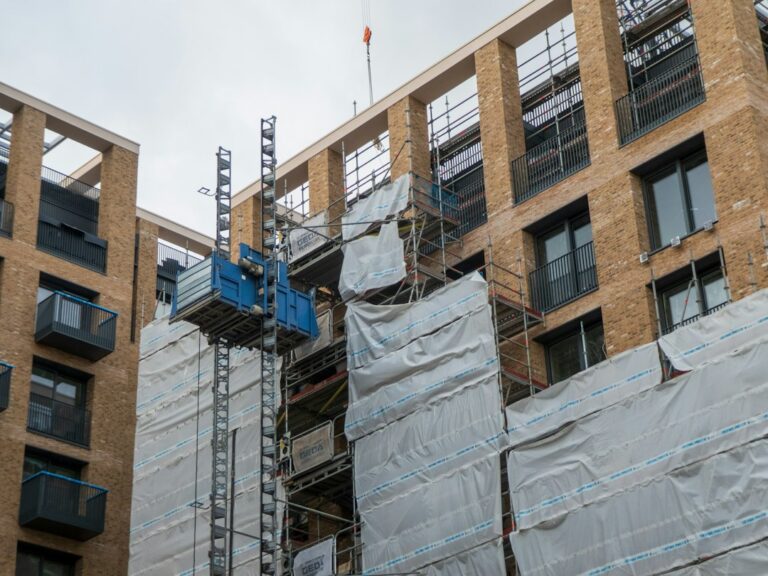
What is a multifamily home?
A multifamily home is a building that holds two or more separate living units under one roof or on one lot, each with its own kitchen, bathroom and entrance. A duplex, a fourplex, a 12-unit walk-up and a 200-unit garden complex are all multifamily housing.
The U.S. Census Bureau uses a physical test. Attached units count as single-family only if each one has a ground-to-roof wall, its own heating system, its own utility meters and no unit above or below it. Any building where the units fail that test is multifamily. So a stacked condo building is multifamily, and a row of townhouses with separate walls and meters usually is not.
For investors, the more useful line is at five units. Buildings with one to four units are financed like houses, with residential mortgages that look mainly at the borrower’s income and credit. Buildings with five or more units are commercial property: Fannie Mae’s multifamily loans, for example, require at least five units, and the lender sizes the loan mainly on the building’s income.
| Type | Typical units | How it is usually financed | Who usually owns it |
|---|---|---|---|
| Duplex, triplex, fourplex | 2 to 4 | Residential mortgage (FHA, conventional) | Individuals, often owner-occupants |
| Small apartment building | 5 to 50 | Bank loan or agency small-loan program | Individuals, families, small partnerships |
| Garden-style complex | 50 to 400+ | Agency (Fannie Mae, Freddie Mac), HUD or bank debt | Syndications, funds, private owners |
| Mid-rise and high-rise | 50 to 500+ | Agency, life company, bank or construction debt | Institutions, REITs, larger sponsors |
How multifamily real estate investing works
Multifamily real estate investing works by collecting rent from many households at one address, paying the building’s costs and the loan, and keeping what is left, then selling or refinancing later. The investor earns from cash flow while holding and from any gain in value when the building sells.
Value in apartment buildings is tied to income. Commercial appraisers price a five-plus unit building mainly by its net operating income, or NOI, divided by a market capitalization rate. That is the biggest difference from houses, which are priced by comparing recent sales of similar homes. If an owner raises NOI by $20,000 a year in a market where similar buildings trade at a 6% cap rate, the building is worth roughly $333,000 more on paper. The same math works in reverse when expenses climb.
Most multifamily investments use debt. A loan lets the owner buy a larger building with less cash, which magnifies both gains and losses. The lender is paid before the owner from every rent check, so the loan terms shape the investment as much as the property does.
Multifamily vs single-family rentals
Multifamily rentals put more units, tenants and income in one place, while single-family rentals spread the same number of doors across many properties. Neither is better in every case. They suit different budgets, skills and goals.
One vacancy in a single-family rental cuts that property’s income to zero. One vacancy in a 20-unit building cuts it by about 5%. Apartment buildings also share one roof, one boiler and one manager across many units, which can lower the cost per unit. Houses are easier to buy, finance and sell, and they attract a larger pool of buyers when you exit.
| Factor | Multifamily (5+ units) | Single-family rental |
|---|---|---|
| How value is set | Mostly by NOI and cap rate | Mostly by comparable home sales |
| Effect of one vacancy | Small share of income | All of that property’s income |
| Financing | Commercial loan sized on property income | Residential mortgage sized on your income |
| Management | Often a professional manager, sometimes on site | Often the owner or a small manager |
| Cash needed to start | Larger, unless investing through a syndication or REIT | Smaller |
| Buyer pool at sale | Investors and institutions | Investors and owner-occupants |
How to invest in apartment buildings: five ways
You can invest in apartment buildings five ways: live in a small multifamily and rent the other units, buy a building yourself, buy into a private syndication or fund, buy shares of an apartment REIT, or exchange into a Delaware statutory trust. The route decides how much control you have, how much cash you need and how easily you can get out.
- Owner-occupied small multifamily: live in one unit of a duplex to fourplex and rent the others. FHA-insured loans under Section 203(b) cover owner-occupied one- to four-unit homes with as little as 3.5% down.
- Direct purchase of a five-plus unit building: you hold title, sign the loan and hire the manager. Our guide on how to buy an apartment building covers the steps and costs.
- Syndication or private fund: a sponsor buys and runs the building and investors own shares of the entity that owns it. You have little control and your money is usually locked up for years.
- Apartment REITs: publicly traded companies that own thousands of units. You can buy or sell shares on any trading day, but the price moves with the stock market.
- Delaware statutory trust: a passive interest that can qualify as 1031 replacement property, used mostly by owners selling another building.
How multifamily returns are measured
Multifamily returns are measured with a handful of standard ratios, each answering a different question. Cap rate describes the building without debt. Cash-on-cash return describes your cash yield after the loan. IRR and equity multiple describe the whole hold from purchase to sale.
No single number tells you enough. A high cap rate can mean a bargain or a building in trouble. A strong cash-on-cash return can come from an interest-only loan that resets later. Read these measures together, and always ask what assumptions sit behind a figure someone shows you.
| Measure | Formula | What it tells you |
|---|---|---|
| Net operating income (NOI) | Rent and other income, minus vacancy and operating expenses (not the loan) | What the building earns before financing |
| Cap rate | NOI ÷ purchase price or value | The unlevered yield; used to compare and price buildings |
| Debt service coverage ratio (DSCR) | NOI ÷ annual loan payments | How much cushion covers the mortgage; lenders set minimums |
| Cash-on-cash return | Annual cash flow after debt service ÷ total cash invested | Your yearly cash yield on the money you put in |
| Internal rate of return (IRR) | The discount rate that sets all cash flows, including sale proceeds, to zero | The annualized return over the full hold, weighted for timing |
| Equity multiple | Total cash returned ÷ total cash invested | How many times your money came back, ignoring timing |
What drives multifamily real estate returns
Multifamily returns come from four sources: cash flow while you hold, paying down the loan, growth in NOI and the price the building fetches when sold. Taxes then decide how much of each you keep.
- Rents and occupancy: the top line. Local job growth, new supply nearby and the building’s condition all push rents up or down.
- Operating expenses: property taxes, insurance, repairs, utilities, payroll and management. Insurance and taxes can rise faster than rent, and a reassessment after a sale can raise the tax bill sharply.
- Financing: the interest rate, amortization, interest-only period and maturity date. A loan that comes due in a weak market can force a sale or a cash infusion.
- Purchase price and exit cap rate: a building bought at a 5% cap rate and sold at a 6% cap rate loses value even if NOI is unchanged.
- Capital spending: roofs, boilers, parking lots and unit renovations. Underfunded repairs show up later as vacancies or emergency costs.
- Management and fees: who runs the property, and in a syndication, the sponsor’s fees and profit split.
Worked example: measuring a 24-unit building
Here is how the measures above are calculated for one hypothetical building.
The building has 24 units renting at $1,400 a month, for gross potential rent of $403,200 a year. Allowing 5% for vacancy and bad debt ($20,160) and adding $7,200 of laundry and parking income gives effective gross income of $390,240. Operating expenses of $175,600, about 45% of income, leave NOI of $214,640.
At a $3,600,000 purchase price, the cap rate is $214,640 ÷ $3,600,000, or about 5.96%. The buyer borrows 60% of the price, $2,160,000, at an assumed 6.25% fixed rate over 30 years. Monthly payments are $13,299.49, or $159,594 a year. DSCR is $214,640 ÷ $159,594, or 1.34x, which clears the 1.25x minimum Fannie Mae lists for its conventional multifamily loans.
Cash flow after debt service is $55,046. The buyer’s cash in the deal is the $1,440,000 down payment plus an assumed $90,000 of closing costs, or $1,530,000. Cash-on-cash return is $55,046 ÷ $1,530,000, or 3.6%. Loan payments in the first year also cut the principal by about $25,311, which adds to equity but not to cash in hand.
Two lessons come out of this. First, the cash yield on a building bought with moderate debt can be lower than its cap rate when the loan constant, the annual payment as a share of the loan (about 7.39% here), is above the cap rate. Second, IRR and equity multiple cannot be known until the building sells, because they depend on the sale price. Any figure for them before then is an estimate built on assumptions you should test.
The risks of multifamily investments
Every multifamily investment can lose money, and a leveraged one can lose all of the equity. These are the risks that cause most losses.
- Debt and refinancing: floating-rate loans can rise, and a fixed-rate loan that matures when values are down may not refinance for the full balance.
- Rising cap rates: when interest rates rise, buyers pay less for the same NOI, so values can fall even when the building is full.
- Expense growth: insurance, property taxes and labor can grow faster than rents.
- Local supply and demand: a wave of new apartments or the loss of a large employer can push vacancy up in a single submarket.
- Regulation: rent stabilization, eviction rules and code enforcement differ by state and city and can limit rent increases.
- Physical condition: older buildings can hide plumbing, roofing, electrical or environmental problems that cost far more than expected.
- Operator risk: in passive deals, the sponsor’s skill and honesty decide much of the outcome.
- Liquidity: buildings take months to sell, and private interests usually cannot be sold before the building is.
How multifamily real estate is taxed
Multifamily property gets the same federal tax treatment as other rental real estate, and depreciation is the largest benefit. The building, but not the land, is depreciated over 27.5 years under IRS Publication 527, so a $3,000,000 building basis produces about $109,000 of deductions a year.
A cost segregation study can move part of the cost into 5-, 7- and 15-year property. Under the 2025 tax law (Public Law 119-21), the IRS says 100% bonus depreciation is permanent for qualified property acquired after January 19, 2025, so those shorter-life parts can often be deducted in the first year.
Rental losses are generally passive under Section 469 and offset only passive income unless you qualify as a real estate professional. When you sell, depreciation taken is taxed at up to 25% as unrecaptured Section 1250 gain, the rest of a long-term gain at 0%, 15% or 20%, and higher earners may owe the 3.8% net investment income tax. A Section 1031 exchange can defer the tax if you identify replacement property within 45 days and close within 180 days.
Who multifamily real estate investors are
Multifamily real estate investors range from a first-time buyer living in one side of a duplex to pension funds that own tens of thousands of units. In between are local owners with a few buildings, families who have held one property for decades, private syndicators and the passive investors who back them.
Most private syndications are for accredited investors. The SEC defines an accredited individual as someone with net worth over $1 million, not counting a primary residence, or income over $200,000 ($300,000 with a spouse or partner) in each of the prior two years. Offerings under Rule 506(b) cannot advertise and may admit up to 35 sophisticated non-accredited investors, while Rule 506(c) offerings may advertise but must verify that every investor is accredited. Investors who do not qualify can still own apartments through REITs or by buying a small building themselves.
Is multifamily housing investment a fit for you?
Multifamily housing investing fits people who can leave money in place for years, accept that income and value move with the local economy, and either want to run property or trust someone else to. It fits poorly if you may need the money soon or cannot stomach a year of no distributions.
- How long can this money stay invested, with a cushion for a longer hold than planned?
- Do you want to make the decisions, or would you rather judge an operator and step back?
- Can you absorb a capital call, a pause in distributions or a total loss of this amount?
- Will the investment sit in a taxable account, where depreciation helps, or a retirement account, where it does not?
- Do you understand the loan: its rate, its maturity date and whether anyone signed personally?
Investing in multifamily with Skyline
Skyline Capital Investments buys apartment buildings with five or more units, and our investor network is for people who want to hear about multifamily opportunities and receive our educational material. Any offering is made only through official offering documents to eligible investors.
Most syndications are for accredited investors, and whether an offering uses Rule 506(b) or 506(c) changes how a sponsor can discuss it and how eligibility is checked. Read the documents in full, ask questions in writing and compare us with other sponsors before you decide anything.