Flagstaff rental demand rests on an unusual combination: renters make up a majority of the city’s households, Northern Arizona University keeps thousands of students in the off-campus market, and a diverse base of employers sits inside a city that has very little private land to grow into. Those forces have kept vacancy low and pushed rents well above the Coconino County median, even as the population grows only slowly.
This article looks at each source of that demand using Census, university, HUD and City of Flagstaff data, then at the policy and supply factors that shape how much of it existing apartment buildings capture.
A city where most households rent
Flagstaff is an incorporated city in Coconino County, and its housing tenure stands out. The Census Bureau’s QuickFacts comparison of Flagstaff and Coconino County puts the city’s owner-occupied housing rate at 42.3% for 2020 to 2024, which means roughly 58% of occupied homes are rented. Countywide, the owner-occupied rate is 59.7%, so the city is far more renter-heavy than the region around it.
The same data shows how rent and income line up:
- Median gross rent in Flagstaff: $1,645 (2020–2024)
- Median household income in Flagstaff: $71,512 (2024 dollars)
- Median gross rent in Coconino County: $1,473
- Median household income in Coconino County: $72,966
Flagstaff’s median rent is about $170 a month higher than the county’s, while its median income is slightly lower. That gap is one measure of how tight the city’s rental market is relative to its surroundings.
Slow population growth, steady renter turnover
Population growth is modest. Flagstaff counted 76,831 residents in the 2020 Census and had an estimated 77,260 on July 1, 2025. Coconino County, by contrast, slipped from 145,101 in 2020 to an estimated 144,368 in 2025. The contrast suggests that within the county, people and jobs continue to concentrate in Flagstaff, which holds the university, the regional hospital and most of the county’s major employers, while smaller communities elsewhere in the county lose residents.
Flat headcounts can hide a lot of movement in a rental market. In Flagstaff, a large share of renters are students, seasonal hospitality workers and medical or research staff on fixed-term roles, so leases turn over regularly even when the total population barely changes. For an apartment owner, that means demand comes less from net newcomers and more from a steady cycle of move-outs and move-ins, which rewards buildings that lease efficiently around the academic calendar.
Northern Arizona University and the student rental cycle
Northern Arizona University is the single largest influence on Flagstaff’s rental market. According to NAU’s 2025–26 Common Data Set, the university enrolled 27,184 students across all locations in fall 2025, including 22,203 undergraduates. The same report shows that 43% of undergraduates lived in college housing and 57% lived off campus or commuted, while 86% of first-year students lived on campus.
That split defines the student rental cycle. Most first-year students live in residence halls, and many move into the private market in their second year. NAU’s most recent campus-level breakdown, in its 2024–25 Fact Book, counted 21,398 students at the Flagstaff campus in fall 2024, a figure that combines Flagstaff with the Phoenix biomedical campus and represents about three-quarters of total enrollment.
On-campus housing is nearly full
The Fact Book also shows how little slack is left in university housing. In fall 2024, NAU had 8,269 beds holding 8,113 students, roughly 98% occupancy. That count excludes three privately operated properties on campus, Hilltop Townhomes, Skyview and The Suites. When residence halls are that full, any increase in students who want to live near campus flows directly into the private rental market. NAU’s Campus Living office separately describes nearly 10,300 students living on campus, a figure that includes the privately operated properties. Either way, the university houses fewer than half of its Flagstaff-area students, and the rest compete for apartments, duplexes and rented houses in the surrounding neighborhoods.
Enrollment is the variable to watch
Student demand is not guaranteed. News coverage of Arizona universities in 2026 reported that NAU projected a decline in enrollment for fall 2026 compared with fall 2025, with the university later saying the drop would be smaller than first expected. Official fall 2026 figures were not yet published when this article was written. For owners of buildings close to campus, the size of that change is the most important near-term demand question in the city.
HUD’s 2023 market analysis puts student demand in perspective: off-campus student households accounted for an estimated 12% of all renter households in the Flagstaff housing market area. Students matter a great deal in the blocks around campus, but most of the city’s renters are not students.
Flagstaff’s employer base beyond the university
HUD’s Comprehensive Housing Market Analysis for Flagstaff, with data current as of July 1, 2023, lists the area’s largest employers (school districts excluded):
- Northern Arizona University: 2,825
- Flagstaff Medical Center: 2,350
- W. L. Gore & Associates: 2,200
- Coconino County: 1,200
- City of Flagstaff: 990
- Walmart: 630
- Twin Arrows Navajo Casino Resort: 510
- Grand Canyon Railway: 420
- Coconino Community College: 310
- Nestlé Purina PetCare: 300
Several of those employers create a different kind of renter than the student market does. Hospital staff, including traveling nurses and residents, often need housing for a defined period. W. L. Gore’s local operations bring engineers and technicians who may rent before they buy in a high-cost market. Government and college employees round out a base of renters with steady paychecks.
HUD reported nonfarm payrolls averaging 68,200 jobs in the 12 months through June 2023. The list is a snapshot from that date, and the ranking has shifted over time, so owners should treat it as an indication of which industries matter rather than a current headcount.
Tourism, hospitality wages and the workforce renter
Flagstaff is a gateway city. HUD notes that Grand Canyon National Park alone received 4.73 million visitors in 2022, and that leisure and hospitality accounted for 16,000 jobs, or 23% of all nonfarm payroll jobs in the market area. That is a large share of the local economy in an industry where wages are typically lower and work is often seasonal.
Wages in Flagstaff are also set by a local minimum wage that is well above the state’s. News reports from AZFamily and Fox 10 put Flagstaff’s minimum wage at $18.35 an hour in 2026, compared with $15.15 statewide, with another increase scheduled for 2027. A higher wage floor supports what hospitality and retail workers can pay in rent, though it also raises payroll costs for property owners who employ on-site staff.
For apartment owners, the hospitality workforce is a core part of demand for older, more modest units. These renters tend to be price-sensitive, which makes them less likely to move into new luxury product and more likely to stay in well-run older buildings.
Why land limits matter so much in Flagstaff
Supply is constrained by geography. Coconino County covers a vast area, but very little of it is private land. The Coconino County government reports that 27.31% of county land is national forest, and a county land composition chart from 2012 shows about 39% in tribal reservations, about 9% state land, about 5% Bureau of Land Management land and only about 12% in private hands.
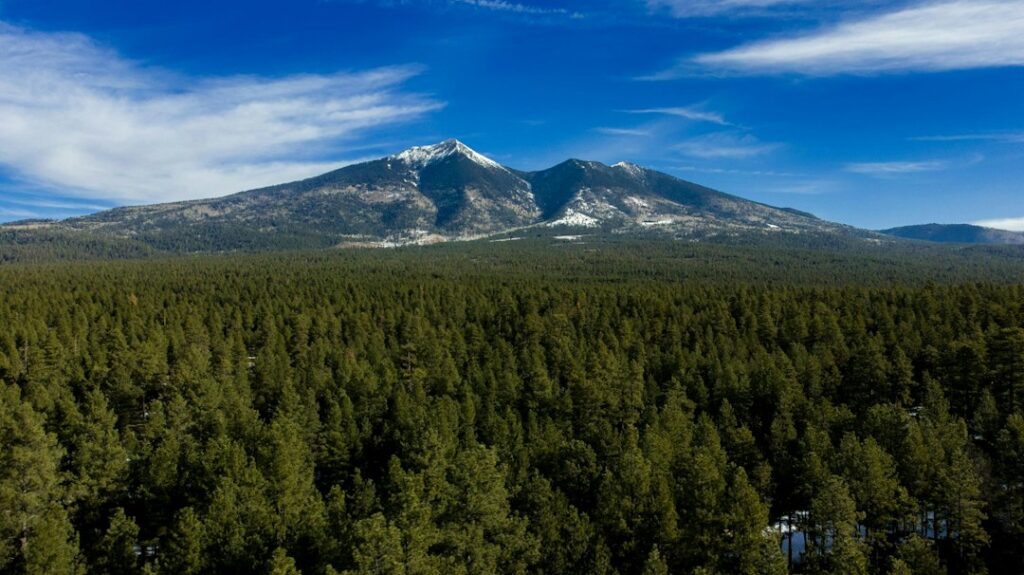
Flagstaff sits within a landscape dominated by the Coconino National Forest. With limited room to expand outward, new housing has to come from infill, redevelopment or the relatively few large parcels still available. That makes it harder for new supply to catch up with demand, which helps explain why rents in the city run above the county median.
How tight is the Flagstaff rental market?
HUD’s 2023 analysis provides the most recent official snapshot of vacancy and rents:
- The overall rental vacancy rate was estimated at 5.4%, down from 8.8% in April 2020.
- Apartment vacancy was 4.9% in the second quarter of 2023.
- The average market effective apartment rent was $1,968, which HUD described as the highest in the market area in recent years.
- HUD projected demand for 1,100 new rental units over the following three years.
At the time, HUD noted no known student housing developments under way and identified projects such as the 220-unit Elkwood Apartments, a mixed-use development. Conditions have changed since mid-2023, so these figures are best read as a baseline rather than a description of today’s market.
The city’s own reporting adds an affordability lens. Flagstaff’s 18-month report on its housing plan found that 38.9% of Flagstaff households with housing payments were cost-burdened in 2023 data. The two-bedroom Fair Market Rent rose 51.5% between 2013 and 2023, to $1,863 a month, while Area Median Income rose 46.5% and the median home sales price rose almost 136%, to $625,000.
That last comparison matters for rental demand. When home prices rise faster than incomes, more households who might otherwise buy keep renting. In Flagstaff, the gap between rents and home prices helps keep long-term renters in the market.
City housing policy and rental supply
Flagstaff has made housing a formal emergency. The City Council declared a housing emergency on December 1, 2020, and adopted a 10-Year Housing Plan on February 15, 2022. According to the city’s 2026–27 implementation plan for the 10-Year Housing Plan, the goals are to create or preserve 7,976 housing units by 2031, with at least 10% of them affordable, and to impact at least 6,000 low-to-moderate income residents.
The plan also refers to Proposition 442, a $20 million bond that voters considered in November 2022, which the city describes as authorizing funds to create rental and homeownership opportunities for Flagstaff residents. Public investment of this kind tends to focus on income-restricted housing, so it competes most directly with older, lower-rent buildings rather than with high-end product.
State rules that shape the market
Two Arizona laws frame what the city can and cannot do:
- No rent control. Arizona prohibits cities, including charter cities, from controlling rents under A.R.S. 33-1329. Flagstaff cannot cap rents on private apartments, so rent levels respond to supply and demand.
- Short-term rentals cannot be banned. Senate Bill 1350, signed in 2016 and now codified at A.R.S. 9-500.39, bars cities from prohibiting vacation or short-term rentals, though cities may require a permit or license.
Flagstaff began licensing short-term rentals on November 1, 2023. KNAU reported at the time that the license costs $175, operating without one carries a $1,000 monthly fine, and that there were 1,045 individual short-term rentals in the city. In a tourist market with scarce land, every home used for nightly rentals is one that is not available to long-term renters, which adds to pressure on the apartment stock.
Matching Flagstaff buildings to renter segments
Because demand comes from several distinct groups, the same city can behave like several different rental markets. Thinking about which group a building serves helps explain its leasing pattern and its risks:
- Student-oriented buildings near campus. These lease heavily around the academic year, often with roommates splitting larger units. They benefit from residence halls running near capacity and are the most exposed to any change in NAU enrollment.
- Workforce housing in older complexes. Hospitality, retail and service workers paid near the local minimum wage look for the lowest rent that still offers a reasonable commute. These buildings compete with publicly supported affordable housing and with each other on price and condition.
- Professional and medical renters. Hospital staff, county and city employees and engineers at manufacturers such as W. L. Gore often want newer finishes, parking and quieter settings away from the student core. With a median home price that had reached $625,000 in the city’s 2023 data, many of them rent for longer than they would in a cheaper market.
- Seasonal and short-stay demand. The visitor economy and the short-term rental market pull some housing out of the long-term pool, which indirectly supports occupancy in conventional apartments.
A building that understands its renter segment can set lease terms, unit mix and amenities to fit. A buyer evaluating the same building will look at the same thing: how dependable its particular slice of Flagstaff demand is likely to be.
What this means for apartment owners in Flagstaff
Putting these pieces together, a few practical takeaways stand out:
- Demand is broad, not only student-driven. Students matter near campus, but healthcare, manufacturing, government and hospitality workers make up most of the renter base.
- Location relative to campus changes the leasing pattern. Buildings near NAU should plan around academic-year turnover and watch the official fall 2026 enrollment count closely. Buildings elsewhere lean more on workforce renters.
- Supply will stay constrained. National forest boundaries, limited private land and a high cost of building mean new deliveries are unlikely to flood the market, even with public support for new housing.
- Affordability is the ceiling. With nearly four in ten households cost-burdened, there is a practical limit on how far rents can rise, especially for older units serving the hospitality workforce.
- Operating costs reflect local wages. The city’s higher minimum wage applies to on-site staff, which should be built into any budget.
These are the dynamics that underpin rents and occupancy, and they are the same factors a buyer will weigh when pricing an existing building.
If you want to understand how these demand drivers translate into value, our apartment building value calculator shows how rent, vacancy and expenses combine into an estimate. For context on statewide trends, see our Arizona multifamily market page. If you are thinking about a sale, our Flagstaff market page explains how we evaluate buildings in the city and what we look for in local properties.
Flagstaff’s mix of students, steady institutional employers, tourism jobs and limited land is unusual among Arizona cities. For apartment owners, the result is a market where demand depends less on rapid population growth and more on a constant flow of renters who need to live close to the university, the hospital, the industrial employers and the visitor economy.